


Report on the 2022 Intensive Workshop in Leipzig
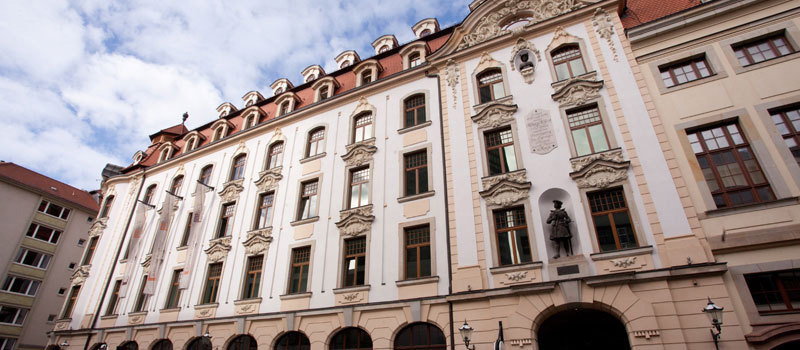 Foto: Veit Mette
The intensive workshop of the Japanese Law Department took place on 21 and 22 October in cooperation with the Department of Japanese Studies at the FernUniversität campus in Leipzig.
Following a pleasant lunch, Ms. Ulrike Heinze of the Leipzig University Library was kind enough to give the participants a guided tour of the East Asian section and to highlight the unique challenges of the Leipzig location as well as the development of the department.
Following a brief introduction by Prof. Weitzdörfer, Felix Jawinski from the University of Leipzig gave a presentation. He was unable to attend in person, but fortunately he had recorded his presentation so that the audience could still share his insights. Mr. Jawinski explained how Japan came to establish a nuclear infrastructure. In particular, he highlighted how the term genpatsu (“nuclear power plant”– in contrast to genbaku “atomic bomb”) has received significant media attention in Japan and how nuclear energy was portrayed in the media as a peaceful and, above all, safe means of generating energy. Mr. Jawinski explained how, as always, similar patterns of reasoning in favor of nuclear energy had made it possible to significantly expand the nuclear power plant network, despite the experience of destruction caused by the atomic bombs at the end of World War II and the public’s “skepticism toward nuclear power.” For more information about the background of the project, please visit: https://gepris.dfg.de/gepris/projekt/406798635?language=en
Marc Nalenz and Stephanie Krampe then presented their latest research findings and work to the audience. Mr. Nalenz’ presentation related to securities law: He explained and compared the legal concept of derivative shareholder suits (“derivative action”) in Japan (Art. 847 of the Companies Act) and Germany (Section 148 of the German Stock Corporation Act) against the backdrop of a ruling by the Tokyo District Court regarding the liability of the former management of the energy company and nuclear power plant operator TEPCO. In particular, he noted that the legal barriers in Germany to minority shareholders asserting claims on behalf of the corporation against members of management (especially due to strict requirements for admissibility of claims) are significantly higher than in Japan. The (non-final) ruling of 17 June 2022 stems from such a derivative shareholder action and orders four former TEPCO executives to pay TEPCO $95 billion in damages for the consequences of the Fukushima Daiichi disaster.
In her bachelor’s thesis, for which she was awarded the top grade, Ms Krampe examined the extent to which regulatory failure can be regarded as a contributing factor to the Fukushima disaster. Ms Krampe concluded that, even though the existence of adequate regulatory instruments could not have ruled out the occurrence of the disaster entirely, the conspicuous absence of such instruments did at least contribute to the severity of the disaster at Fukushima Dai’ichi. The industry’s ability to influence the interests of various political and bureaucratic players is facilitated by the prevailing institutional framework, in the form of legislation and social consensus, and this has often made it easier for nuclear power plant operators to circumvent stricter safety measures and the associated costs.
In his highly interesting lecture on the topic of “Citizens’ Committees and the right to bring a private prosecution in Japanese criminal proceedings,” Prof. Kazushige Doi talked about the role of the citizens’ committee, which is intended to serve as a means of promoting greater democracy within criminal proceedings and in the run-up to them. The small number of cases that are actually successfully prosecuted came as something of a surprise. The question as to the limitations and usefulness of this tool sparked a great deal of discussion and raised a number of queries.
To round off the day, the group was given an evening tour of the impressive Federal Administrative Court, which has a rich and eventful history.
Leon Ritter kicked off the second day of the retreat with his presentation. Mr Ritter presented his dissertation topic – an examination of laws regulating hate speech from an international comparative perspective – to the participating researchers from Hagen and Leipzig. His lecture outlined his research interests and described how he attempts to explain a legal phenomenon using methods from the empirical social sciences. The key question he seeks to answer through his research project is what lies behind the divergence in regulatory approaches across different jurisdictions. He explained that his research design is interdisciplinary in nature and combines the fields of law and social sciences. With the emergence of new spaces for communication as a result of the ongoing digitalization of society, issues relating to the regulation of hate speech and the protection of freedom of expression are becoming increasingly crucial to ensuring peaceful coexistence in democratic societies, making Mr Ritter’s research topic all the more relevant.
Later that morning, Dr. Dorothea Mladenova, a postdoctoral researcher in Japanese Studies at Leipzig University, presented her findings on post-colonial and post-migrant memory work and transnational feminism, using the ‘Peace Statue’ in Berlin as an example. At the time, this and the way it was presented caused a stir in the media and met with resistance in Japan. Among other things, Ms Mladenova shed light on the background and motives of the civil society alliance behind the statue. What was particularly interesting were the photographs showing the students in Leipzig interacting with the Peace Statue as part of a series of lectures. The discussion the followed the talk focused, among other things, on the question of how the ‘appropriation’ of the comfort women’s fate is received within the broader movement against the far right, and how those affected deal with it. The discussion also touched on how Japanese people deal with such a direct confrontation with a sense of responsibility – if not guilt. Background information can be found here: https://www.uni-leipzig.de/newsdetail/artikel/7-was-bedeutet-es-dass-eine-friedensstatue-in-form-einer-trostfrauaufgestellt-wurde-2020-10-05
This was followed by an overview of the current state of research and academic exchange, based on various events and symposia that Prof. Weitzdörfer and Mr Ritter had recently attended. One interesting point was the anticipated decline in research into Japanese law on the American continent.
After lunch, Ms Karina Hermes provided an insight into her work as a certified translator for Japanese and German. She highlighted particular challenges and pitfalls using a number of examples she had brought along with her. One point that sparked a great deal of interest during the discussion was the fact that Japanese family registers, which are very often used as a ‘universal document’, can contain a veritable wealth of information about third parties. Both the speaker and the audience saw this as a potential problem.
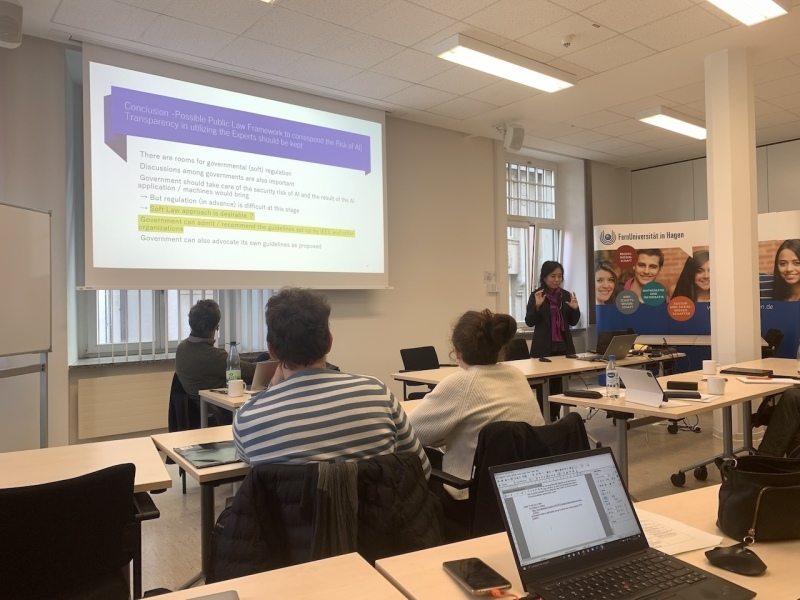 Foto: Marc Nalenz
The official presentations concluded with a talk by Prof. Mayu Terada titled “AI and Law in Japan.” Prof. Terada outlined the challenges facing Japanese law with regard to artificial intelligence. Among other things, she made it clear that there is no consistent legislation governing the regulation of artificial intelligence and clarifying responsibilities in this area. Furthermore, the current situation is such that individual ministries and authorities are each tackling the issue of artificial intelligence on their own, and this approach tends to be seen as a ‘reaction’ rather than ‘action or prevention’.
Finally, the chapter on Japanese environmental law, which Prof. Weitzdörfer had been working on for the Elgar Encyclopedia of Asian Law, successfully rounded off the event. This marked the official end of the retreat.
The aim of the event was to support early-career researchers in the Department of Japanese Law at the FernUniversität and the Chair of Japanese Studies at Leipzig University, and to facilitate academic exchange between the two departments. Both groups were given the opportunity to present their work as talks and to gain valuable insights and suggestions from the questions and discussions. The relaxed and pleasant atmosphere was highly conducive to sharing and discussing ideas. In addition, the attendees particularly benefited from the presentations given by leading experts in their field: Prof. Doi, Prof. Terada and Prof. des. Mladenova. In addition, the University of Leipzig, which is playing a key role in the DFG research project on Fukushima entitled “split society”, provided an insight into the current state of research.
