


From Harvard to Hagen
Julius Weitzdörfer is Junior Professor of East Asian Law at Hagen University. Following his time working as a Junior Faculty Member at Harvard, he now researches and teaches at the Institute for International Legal Relations.
 Foto: FernUniversität in Hagen
If you ask him what connects Hagen University with Harvard University – arguably one of the world’s greatest institutions of higher education – Julius Weitzdörfer doesn’t need to think long before answering: “Both are relatively compact campus universities, and both conduct first-class research into Japanese law.” He has been head of the Department of East Asian Law at the University of Hagen since 1 September 2020. The department has been part of the Institute for International Legal Relations since 2016, and the newly appointed junior professor will serve as its co-director.
Born in Germany’s Palatinate region, he went on to study Japanese studies and journalism in Leipzig and Tokyo, and later law in Hamburg and Shanghai. Scholarships then took him to the universities of Kyoto and Frankfurt. By the time he received the call to Hagen, his CV already featured two elite institutions: Cambridge and Harvard. At Cambridge, he taught environmental law and conservation governance, with a research focus on global catastrophic and existential risks (from 2013). In 2019, he joined the Harvard Kennedy School of Government's Belfer Center of Science and International Affairs as a Junior Faculty Fellow.
However, Weitzdörfer felt drawn back to Germany. As he explains: “There are only a handful of professorships in my field across Europe. Hagen University offers one of these and is one of the few universities worldwide where the teaching of East Asian law has long been institutionalized. That was a unique opportunity for me.”
East Asia – a rich source for comparative law
Weitzdörfer stumbled upon his specialty, nuclear law, quite literally “by accident,” as he often puts it. He was writing his doctoral thesis on organized financial crime and consumer credit regulation in Japan when the reactor accident in Fukushima occurred in 2011. This was a turning point in his research: “Since then, I have focused on identifying which legal frameworks are needed to prevent similar accidents in the future and how crises and disasters can be managed effectively and equitably.” He hopes his research will succeed in developing solutions that serve the common good.
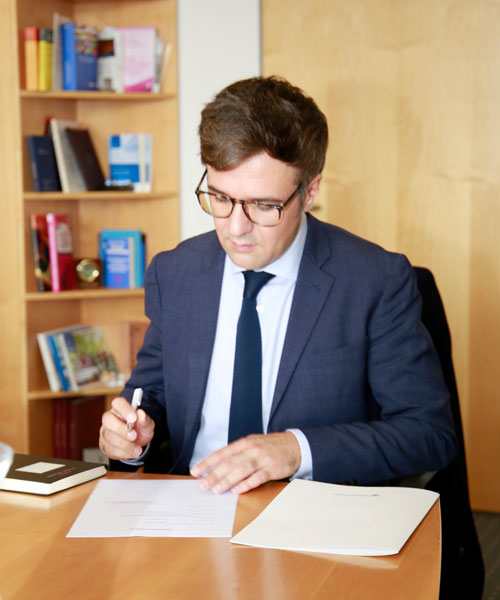 Foto: FernUniversität in Hagen
Hagen University is one of the few universities worldwide where the teaching of East Asian Law has long been institutionalized. That was a unique opportunity for me.
Julius Weitzdörfer
Weitzdörfer’s academic work covers a spectrum that takes in risk regulation, technology policy, and environmental law. The findings from his three-pronged research could be particularly relevant for Germany: “On the one hand, certain technological innovations are adopted earlier in Japan. On the other hand, Japan’s experiences with typhoons and tsunamis provide valuable insights for the legal and financial risk management of extreme events, which are expected to become a more frequent global phenomenon in the future.” He also sees points of contact for Japanese law in the work conducted by Hagen University's research cluster “Energy, Environment & Sustainability.”
Interdisciplinary research, international teaching
During his official appointment interview, the new junior professor received significant encouragement from Hagen University President Ada Pellert. Not only for his ideas to offer English-language lecture series on Japanese law in Hagen in the future. The President also recognized a good link to high-quality teaching: “There are endless possibilities for blended learning in your field, especially if you can integrate all the available channels.” Weitzdörfer eagerly embraces her advice to fully leverage the existing infrastructure for digital teaching. He strongly supports moving beyond traditional methods of teaching current law, as Japan’s legal system offers valuable insights into how law is shaped by cultural, economic, and social conditions: “For me, a much more effective way of arousing students’ interest is to play out practical questions of justice.”
For the time being, he will mainly be doing this while working from his home in Leipzig. But the man, who says he has never owned a car in his life, is also looking forward to working on-site in his office on the campus in Hagen. He doesn’t need one for working at the campus university anyway – neither last semester at Harvard nor this semester in Hagen.
