


News
Petrocultures 2026: Situating Energy
[30.08.2026]International Perspectives on Energy and Transformation
From August 26 to 28, 2026, the international conference “Petrocultures 2026: Situating Energy” took place at TU Dresden. The conference brought together scholars from various disciplines to discuss the cultural, historical, political, and societal dimensions of energy and energy transitions.
CCU in the “The Chemistry of Energy” Panel
In the “The Chemistry of Energy” panel, Léo Schillmöller presented the talk “From Waste Gas to Resource? Stakeholder Expectations and Transition Narratives of CCU in Industrial Transformation.”
From Waste Gas to Resource?
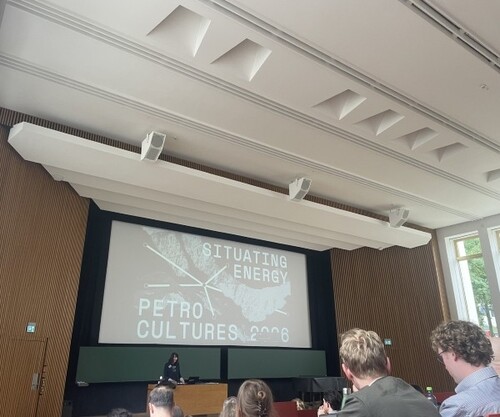 Foto: Léo Schillmöller
The presentation focused on how CCU is discussed and given meaning in the context of industrial transformation. In particular, it examined the expectations that different stakeholders associate with CCU and the narratives used to describe the technology’s future role.
A key aspect of this was the shift in the perception of CO₂. Until now, CO₂ has primarily been viewed as an emission or waste product. From the CCU perspective, the question arises as to whether CO₂ can serve as a potential resource and feedstock for industrial processes.
Different Visions of the Future
The study showed that CCU is associated with different visions of the future of industry. These include, for example, the decarbonization of emission-intensive industries, the establishment of a circular carbon economy, and the development of new industrial value chains.
At the same time, expectations differ regarding the contribution CCU can make to industrial transformation and the conditions under which the technology should be used effectively. CCU thus finds itself at the intersection of technological innovation, climate protection, and the question of how industrial production will be shaped in the future.
Expectations as Part of Industrial Transformation
The paper illustrated that technological transformation pathways are not determined solely by technical feasibility. Expectations for the future and narratives influence how technologies are evaluated, legitimized, and embedded in visions of future industrial systems.
The panel discussion thus revealed that the question of CCU’s future is also a question of what role CO₂, industry, and technological innovation should play in a climate-neutral society.
Further Information
TU Dresden on Petrocultures 2026
Fraunhofer UMSICHT on the Carbon2Chem research project
