


Prof. Dr. Henning Wilts
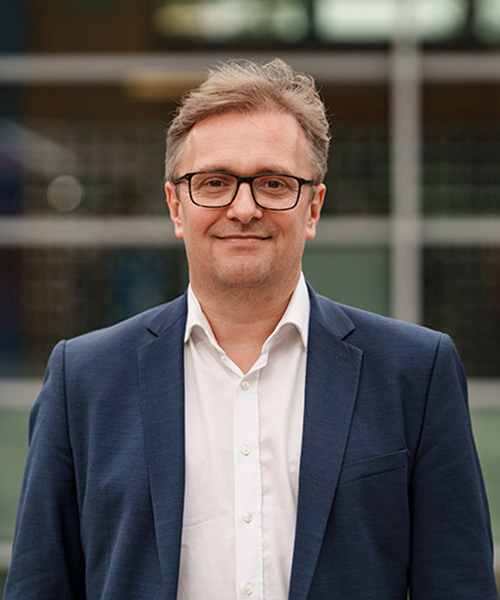 Photo: Volker Wiciok
Contact
Email: henning.wilts
Institutional Affiliation
Faculty of Humanities and Social Sciences
Head of Department for Circular Economy
Research Interests
(in the fields covered by the research center)
Transitioning to a circular economy is a key strategy for reaching the Sustainable Development Goals. In Germany, this path is outlined in the National Circular Economy Strategy, adopted in 2024. This disruptive shift involves much more than just innovative technology: it impacts society as a whole, creating both winners and losers relative to today’s linear system. Furthermore, circular strategies are shaped by societal stakeholders who are integrated into the process in various ways. Ultimately, a profound understanding of this "human factor" is essential to ensure that change is both sustainable and scalable.
-
(in the fields covered by the research center)
- Wilts, H.; Gözet, B. (2026): Ecological rating systems for a circular textile economy, in: Gries, T. (Hrsg.) Circular Textile Economy. München.
- Wilts, H. (2026): Optionen für einen funktionsfähigen Markt für Kunststoffrezyklate, DBU Positionspapier, Osnabrück.
- Turrini, S.; Biggeri, M.; Schmidt, I.; Wilts, H. (2026): Policymakers’ perceptions of the wellbeing economy : emerging patterns and trade-offs in implementation, Frontiers in sustainability 7.
- Wilts, H.; Leske, K. (2026): Nationale Kreislaufwirtschaftsstrategie(n) der EU-Mitgliedstaaten im Vergleich; in Huber-Heim, K., (Hrsg.): Handbuch Kreislaufwirtschaft : Strategien & Geschäftsmodelle, Ressourcenmanagement, Digitalisierung, rechtliche Rahmenbedingungen, Linde, Wien, 413–418.
- Wilts, H. (2026): Zirkuläres Controlling : Entscheidungsunterstützung in Unternehmen, in Sauer, A. (Hrsg.) Handbuch kreislauffähige Wertschöpfung : Schlüsselkonzepte, Technologien, Geschäftsmodelle und Rahmenbedingungen, Springer Gabler, Wiesbaden, 359–372.
- Wilts, H. (2025): Von der Theorie zur Praxis : Policy-Mixe für Verpackungsvermeidung, in: Süßbauer, E., Lüder, C. (Eds.), Precycling, Perspektiven auf die Vermeidung von Verpackungsabfällen, Transcript Verlag, Bielefeld, 194–206.
- Wilts, H. (2025): Pfandsysteme als marktbasierte Anreizstruktur für die Transformation zur Kreislaufwirtschaft, Österreichische Wasser-und Abfallwirtschaft 77, 53–60.
- Böckel, A.; Wilts, H. (2024): Kann ich den Becher hier zurückgeben? Pilotprojekte im Bereiche Mehrwegrückgabe, Erkenntnisse aus Stuttgart, Hamburg, Berlin, München, Wiesbaden und Mainz, Müll und Abfall 56, 436–440.
- Thrän, D.; Edenhofer, O.; Pahle, M.; Schill, E.; Steubing, M.; Wilts, H. (2023): Minderungsansätze in der Energie- und Kreislaufwirtschaft, in: Brasseur, G. et al. (Eds.), Klimawandel in Deutschland : Entwicklung, Folgen, Risiken und Perspektiven. Springer Spektrum, Berlin, pp. 429–437.
- Hummler, A.; Lindner, R.; Posch, D.; Wilts, H.; Wittmann, F.; Wurm, D. (2023): Deutschlands zirkuläre Zukunft: Wie Missionen die Transformation zur Circular Economy beschleunigen, Focus Paper, Bertelsmann-Stiftung, Gütersloh.
- Gözet, B.; Wilts, H. (2022): Kreislaufwirtschaft als Baustein nachhaltiger Entwicklung, in: Meyer, C. (Ed.), “Transforming Our World” : Zukunftsdiskurse zur Umsetzung der UN-Agenda 2030, Transcript Verlag, Bielefeld, 173–179.
- Bahn-Walkowiak, B.; Koop, C; Wilts, H. (2021): Europäische Plattform für die Kreislaufwirtschaft : Forschung und Innovationen zwischen Umweltentlastung und Rebound-Effekt, Ökologisches Wirtschaften 36, 35–40.
- Bitter-Krahe, J.; Turrini, S.; Wilts, H. (2021): Fostering circular cities : a study on urban circularity hotspot frameworks for the Western Balkan region, Wuppertal Institut für Klima, Umwelt, Energie, Wuppertal.
- Wilts, H. (2021): Kreislaufwirtschaft als gesellschaftpolitische Herausforderung, Gesellschaft, Wirtschaft, Politik 70, 371–382.
- Chen, W.-Q.; Ciacci, L.; Geyer, R.; Wilts, H.; Toshiaki, Y. (2019): Sustainable cycles and management of plastics, Resources, conservation and recycling 141, 502–503.
-
(in the fields covered by the research center)
- Improving Circularity and Recyclability of Electric Vehicles
The "Circular E-Cars" Research Training Group (RTG) is dedicated to the challenge of optimizing the recycling of electric vehicles (EVs). While EVs contain valuable non-ferrous metals and innovative composite materials, their recycling has remained inefficient due to time-consuming and cost-intensive disassembly processes. The goal of the "Circular E-Cars" project is to develop innovative approaches for the circularity and recyclability of various material streams from electric vehicles and to establish these within the Rhenish mining area (Rheinisches Revier). In this endeavor, RWTH Aachen University, FH Münster University of Applied Sciences, the University of Siegen, and the Wuppertal Institute are collaborating to transform the Rhenish region into a leading location in this field. - Evaluation of the Update to the Waste Prevention Programme and Development of Strategic Advancement Proposals
Within the framework of this project, researchers are analyzing and evaluating the current state of implementation of the Waste Prevention Programme (WPP) at the federal, state, and local levels, as well as the specific examination mandates contained therein. Building on this—and by further examining previously overlooked waste prevention potentials from other strategies, programs, and countries—they are developing proposals for the further development of the WPP as well as strategic policy recommendations to strengthen the program’s reach and foster the ongoing implementation process. - NKWS Accompanying Research - Scientific Support and Monitoring of the National Circular Economy Strategy (NKWS)
The objective of this accompanying research project is to provide scientific support for the process of developing and updating a National Circular Economy Strategy (NKWS) for a resource-efficient, sustainable, and circular economy, enriching it with discussion papers and further input. As part of the initiative, project participants are developing proposals for a meaningful framework for the strategy, as well as concrete targets for reducing primary raw material consumption and closing material loops. Consequently, they are drafting a consistent system of targets and indicators alongside an effective package of instruments and measures. Particular emphasis is placed on measuring the national and global climate protection effects of the proposed measures. The scientific research is thus intended to accelerate the transformation speed of the NKWS and evolve it into a true circular economy.
- Improving Circularity and Recyclability of Electric Vehicles
