By Dr Prue Goredema
Some speculate that worldwide language learning will go the way of the radio star – side-lined not by video this time, but by AI. Others beg to differ and have conducted studies to back that claim, though, considering that those responding to the question “Will language learning become obsolete?” tend to be language teachers themselves, it would be like turkeys voting for Christmas. For example, in a 2025 study by the British Council and the Research Institute of Digital Innovation in Learning, around half of the 1348 respondents doubted that AI would be able to teach English by 2035.
But perhaps the voices that count the most are those of prospective students. Do they see the value in paying for and painstakingly learning over the course of many years what generative AI can achieve in a few seconds flat?
The latest Eurobarometer Survey on facts and stats pertaining to Europeans and their languages revealed that a good three-quarters of respondents think that “improving language skills should be a policy priority” and a whopping 86% are of the mind that EU citizens should speak at least one language in addition to their mother tongue.
It’s easy enough to see that English isn’t going anywhere any time soon. As the international language of academia, it is the language we focus on at the FernUni Hagen – primarily in our English for Specific Purposes courses, but also in our IELTS preparation course and our upcoming B1 and B2 general English courses.
But what of other European languages?
That is the question my colleagues Ana Isabel Martín Ibáñez, Christophe Peyrani and Roman Hübert and myself have been pondering over the winter months in our new multilingual language café.
The concept is simple. Participants click on the Zoom link at the appointed hour, i.e. 6 -7 pm on the last Monday of each month, and they select a break out room, each clearly marked English, Español, Deutsch or Français. There’s a teacher in each room, their main task being to step in with scaffolding when diction goes downhill or grave syntax errors are committed. Aside from that, conversation, confidence building and connecting are the key goals. There are no grades, no assessments and no pressure to perform.
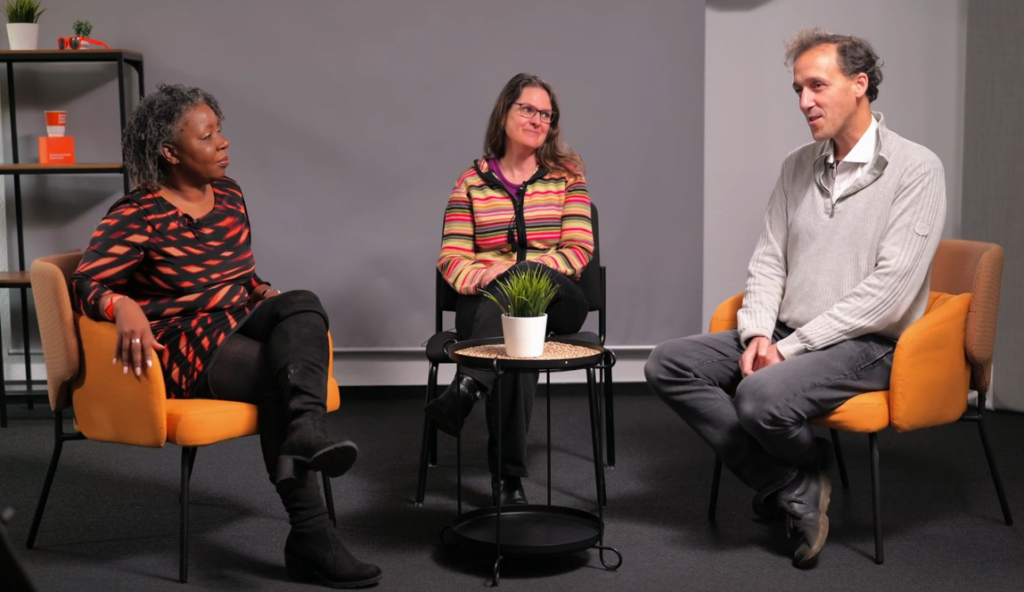
Ana and Christophe teach Spanish and French respectively at the Dortmund University of Applied Sciences and Arts (FH Dortmund) and Roman teaches German at the FernUni. More information is presented in the video All about the Language Café (run time 03:19 mins)
Our Language Café has had mixed fortunes. Whilst we have a steady stream of students showing up to practise their English, the other languages have not always fared too well. One month the language learning aficionados might come out in full force; the next we’re lamenting the future of French.
I am in good company when I assert that being multilingual opens doors that defy description, mental marvels that allow one to truly see the world anew and engage with others in new and invigorating ways. Many studies have been conducted, and those in the know will likewise have anecdotal experience that supports this claim.
Not to mention the social capital one gains from being able to operate multilingually.
With the consolidation of the OpenEU steadily approaching, what better time is there to prepare for the abundant opportunities for mobility, joint degree programme and other aspects of internationalisation?
So, we encourage all those in the FernUni community and beyond to take advantage of this free resource. Our virtual doors are open to anyone who stumbles across our link, and in fact the Language Café has sometimes inadvertently served as a shop window for those curious about what distance learning entails.
The Language Café crew have committed to continuing the experiment into the summer months, and if people votes with their clicks, by linking with us online, we will be very happy to continue into the 2026/2027 academic year. For now, the upcoming meet-up dates are:
- Monday 27 April
- Monday 18 May
- Monday 29 June
And to keep abreast of other developments in English Learning Support, please visit our website.
See you soon at the Language Café!