


Projects of the CATALPA Research Center
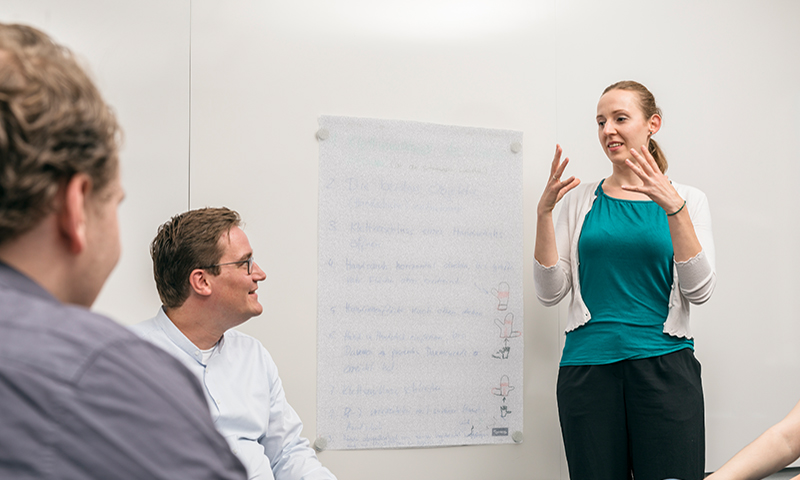 Photo: Henrik Schipper
In our projects, scientists from CATALPA and in-kind project leaders from the faculties use the unique research opportunities of the cluster. Through the connection to the FernUniversität with its numerous and diverse students studying digitally and hybrid, they achieve valid results in the area of the individualization of higher education through the possibilities of digitalization. They are in constant exchange and cooperate with relevant scientific institutions, which can use this special field of research together with CATALPA.
Our interdisciplinary teams from computer science, computational linguistics, psychology, sociology or educational science gain a wide range of insights - from fundamental research to application in large groups.
AI.EDU/AI.EDU 2.0
Artificial intelligence that supports learners and teachers in processing and structuring study content - AI.EDU is researching how exactly this can be achieved. But in order for AI to help learners improve their skills in the first place, teaching and learning processes must first be decoded and described.
APLE / APLE II
Knowing where one's own weaknesses lie, where learning gaps exist, and thus raising awareness of one's own learning process - APLE (I and II) investigates how a digital platform can best support students in their learning success. For example, students receive recommendations for their next learning steps and can reflect on their learning behavior through visualizations.
DAKODA
How can the language of German learners be analyzed automatically? DAKODA is doing the groundwork here. Various learner corpora are merged into a large overall data set with search and filter functions. At the same time, young researchers in the field of German as a foreign language and German as a second language are trained in the handling of large data sets.
DECIDE
Under which circumstances is choice beneficial for students and under which circumstances can it be detrimental? DECIDE explores the consequences of choice in the context of distance learning – also taking into account student diversity.
IMPACT
Better higher education thanks to artificial intelligence - the IMPACT cooperation project not only researches the use of trusted learning analytics and AI in university teaching, but also provides scientific support for implementation.
InterMINT
How can we better support international students in Germany, especially in STEM subjects? In order to answer this question, we must first determine which predictors are crucial for academic success here. The InterMINT project is investigating this with the help of data from the "International Student Survey" study progress panel.
KISS-Pro
Preparing language teachers for the competent use of AI-based systems - that is one of the goals of KISS-Pro. The joint project of four universities develops and tests professionalisation concepts for teachers that address the opportunities, reservations, factual limits and problems of AI in the school context.
LA DIVA
Learners are individual, have different strengths, are in different stages of life, and therefore need different types of support, especially in digital distance learning. This is precisely where LA DIVA comes in and determines the potential of learning analytics.
MULTIDIVERSE-CSCL
Collaboration in virtual study groups is beneficial for students’ sense of belonging and performance in distance education. However, student diversity can impair the collaboration within the study groups. The project investigates the influence of stereotypes on the collaboration and develops technological support for virtual study groups.
NOVA:ea
Is it even possible to test online in a meaningful way? And how can the diversity of students be taken into account? In the NOVA:ea project, study-oriented e-assessments are implemented, scientifically monitored and evaluated - in cooperation with RWTH Aachen University, TH Cologne and the German Institute for Adult Education.
OrA/OrC
The ORC project analyzes the interrelationship between resilience, creativity and educational technologies. It also elaborates concrete recommendations for action for the university as an organization. ORC builds on the OrA project, which looked at the implementation of educational technology in international higher education institutions.
Former Projects
 more
more
Project LAMASS [expired]
Why do some students drop out while others continue successfully? Data on this is based predominantly on the present teaching of traditional universities. If we want to know more about the factors in digital studies, it helps to look at distance learning universities as a comparison group. In the research project LAMASS@DiLea, Prof. Dr. Claudia de Witt's department of educational theory and media pedagogy investigates factors for academic success and dropout in digital study formats and compares these insights directly with traditional studies.
Project KISTRA [expired]
Police crime statistics show a significant increase in politically motivated Internet-related crimes in recent years. Investigating authorities need tools that are tailored to their needs, enable pre-filtering and support them in criminal prosecution. KISTRA explores the possibilities of using Artificial Intelligence to detect, prevent and prosecute crimes. The subproject led by CATALPA research professor Torsten Zesch is specifically concerned with the question of how the criminal liability of hate speech in social media can be modeled computer linguistically.
Project WisPerMed [expired]
The Research Training Group WisPerMed is a highly diversified and interdisciplinary team of computer scientists, pychologists, and physicians. Together we aim for the fusion of Artificial Intelligence and medical decision support to drive forward knowledge and data-based personalization of medicine at the Point of Care.
Project „Explaining AI“ [expired]
Artificial intelligence as a black box? Automatic assessment algorithms that can reliably evaluate learner responses create important capacities for teachers in the education sector. But what if learners can't do anything with the feedback? Explaining AI explores methods to generate helpful feedback using AI in the future.
Project "Do I belong?" [expired]
Does the ethnicity and thus the expectation that students with migration background are stereotyped impair equal opportunities? "Do I belong?" deals with the consequences of perceived stereotype threat for the social inclusion and social relations of young people with a migration background in the German school context.
Project „DivAdapt“ [completed]
The project deals with the description, prediction, and explanation of diversity effects in computer-supported collaborative learning (CSCL). One goal of the project is to develop evidence-based diversity-enriched optimization of CSCL in higher education.
Project „Permeability“ [completed]
This project is concerned with the permeability between vocational education and bachelor’s degree - from IT specialist to bachelor’s degree in computer science.
Project „Universities of the Future“ (HdZ) [completed]
The Universities of the Future project (duration: 1 May 2017 to 30 April 2018) examined the demands of digitalization on universities, their strategic processes, and their politics.
to the project (in German)
