


News
CATALPA Lecture Series with Yizhou Fan
[20.07.2026]Does generative AI improve learning – or merely performance? That was the topic of our CATALPA Lecture Series. Our guest speaker was Yizhou Fan, Assistant Professor at the Graduate School of Education at Peking University.

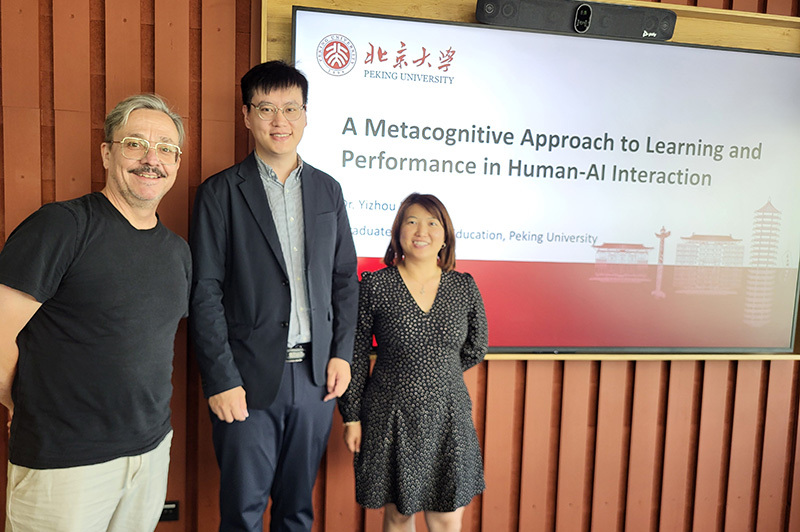 Photo: CATALPA
The CATALPA Lecture Series was back for another round. Our guest, Yizhou Fan, is a long-time collaborator of Lyn Lim, head of the CATALPA junior research group ATLaS (Adaptive Teaching, Learning, and Support). His subject:
A Metacognitive Approach to Learning and Performance in Human-AI Interaction
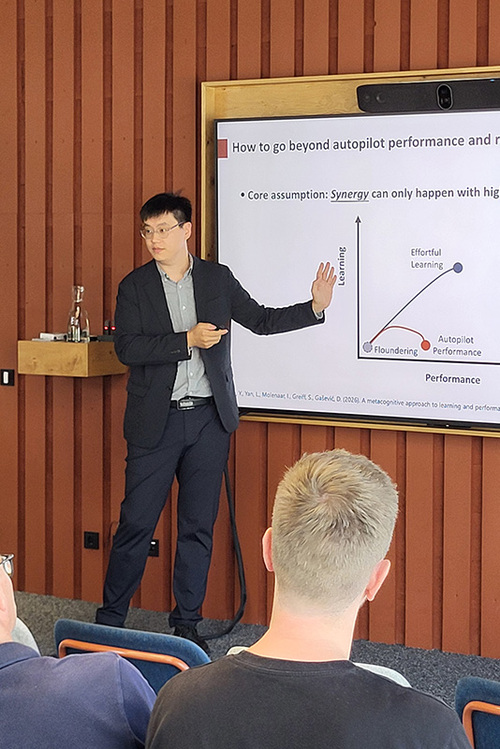 Foto: CATALPA
Generative AI has made it easier than ever for humans to perform well – but not necessarily to learn well. Learners can now outsource drafting, reasoning, feedback, and even evaluation to AI, producing fluent and high-quality outputs with less effort. This creates a critical tension for education and human-AI interaction: when does AI-supported performance become durable human learning, and when does it become a performance illusion?
This is exactly what Dr. Yizhou Fan (Peking University) explores in his research on learning and performance in human-AI interaction. His central claim: learning and performance are two distinct things – and generative AI can decouple them. Students complete tasks faster and "better," without a measurable gain in knowledge or transfer ability. The result: de-skilling, mis-skilling, or even never-skilling – the loss, the flawed formation, or the failure to develop essential competencies.
His answer: deliberately manage metacognitive offloading and onloading.
- Offloading (delegating tasks to AI) isn't inherently bad – but it only makes sense if learners can first judge what a task is actually worth and whether outsourcing it is the right call.
- Onloading means deliberately keeping metacognitive processes (planning, monitoring, reflecting) with the human, or reclaiming them – for example through scaffolding questions, checklists, or reflection steps after using AI.
A simple but powerful takeaway from his studies: think first, then bring in AI – not the other way around. This sequence alone can significantly boost learning outcomes.
His conclusion for higher education: tasks, scaffolding, and assessment need to be rethought – moving toward a genuine understanding of process and competence in the age of human-AI collaboration. That way an actual human-AI-synergy can evolve.
About Yizhou Fan
Yizhou Fan is curently Assistant Professor at Peking University, Graduate School of Education. He is also Adjunct Research Fellow at the Faculty of Information Technology, Monash University, Melbourne. His research focuses on AI in education and AI for science, AI literacy, Learning Analytics, self-regulated learning and learning design.
