News
SRL-Agent: Using AI to Track Your Own Learning Strategies
[27.10.2026]How do students actually learn? Do they plan their time carefully, check their own understanding, and seek help when they get stuck?
 Photo: Veit Mette, Privat
These questions are at the heart of research on self-regulated learning (SRL). This is precisely where the SRL-Agent project comes in.
At its core is a digital interview tool that asks students about their learning strategies in a natural, conversation-like manner. A practical benefit for lecturers: Through a dashboard, they gain a quick overview of where their students stand and can tailor their teaching accordingly.
For Lecturers: How SRL-Agent Can Help
Self-regulated learning is considered one of the strongest predictors of academic success. Students who can plan, monitor, and strategically adjust their learning processes generally perform better in their studies. But how can teachers find out which strategies their students are actually using?
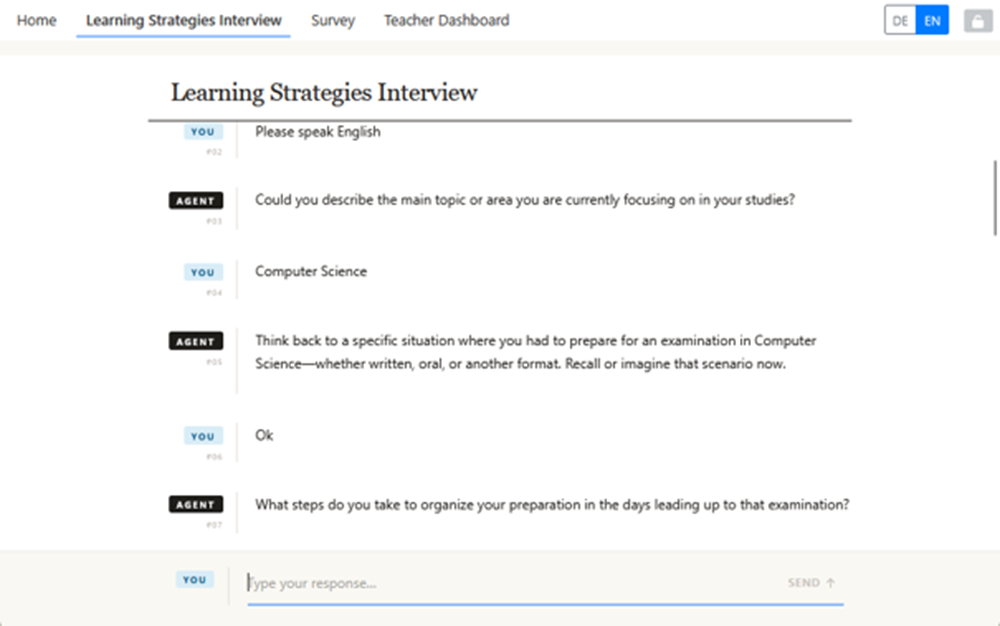 Photo: CATALPA
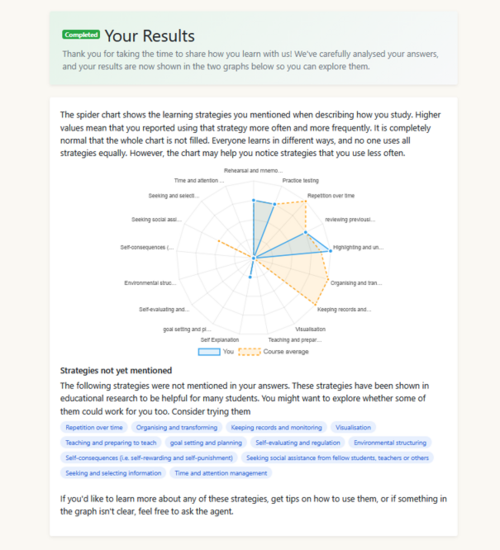
That’s exactly where SRL-Agent comes in. Students engage in a brief, guided conversation with the system – in German or English, whichever works best. The tool asks about typical learning situations – such as how students prepare for an exam or write a term paper – and automatically identifies which learning strategies are being used. Students then indicate how often they use each strategy.
At the end, they receive a personalized summary of the learning strategies they have used and those they have not yet used. The agent responds flexibly to the students’ individual answers, asks specific follow-up questions as needed, and revisits points that have already been discussed as the interview progresses – so no two interviews are alike.
For teachers, this results in a dashboard providing an overview of their students’ results. This makes it possible to see at a glance where a group stands overall, and the lecturers can tailor their teaching more effectively – for example, by providing additional guidance on time management or strategies tailored to the course if it becomes apparent that many students could use support in these areas.
Can Be Integrated into Learning Management Systems
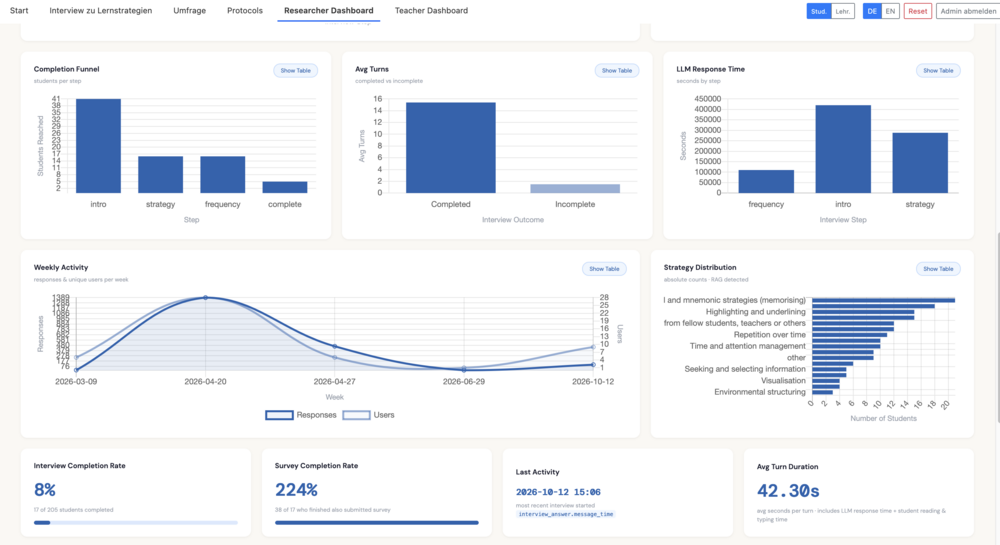 Photo gallery
Important for use in everyday academic life: SRL-Agent can be integrated directly into existing learning platforms such as Moodle or Ilias, allowing students to use it in their usual course environment. Before starting, all participants are informed about the purpose and benefits of the system and must actively consent to its use. At the end, they can view and download their own results. SRL-Agent can also be used multiple times over the course of a semester.
The system has already been used in a FernUni course and has proven itself in practical use.
Brief Overview of SRL-Agent
-
SRL-Agent combines a proven psychological research tool with modern interview technology, making it practical for use in both research and everyday teaching.
-
Its first practical application in a course with students demonstrated that the tool integrates well into existing learning environments and provides valuable insights into learning behavior.
-
Whether used as a standalone application, integrated into Moodle or Ilias, or as a flexibly scalable Docker stack for entire course series: SRL-Agent can be adapted to a wide variety of use cases, from small pilot studies to campus-wide implementation.
-
SRL-Agent is based on the classic structured interview for assessing self-regulated learning strategies developed by Zimmerman and Martinez-Pons (1986). This established protocol has been adapted into an interactive, multi-stage conversation system that guides students through the introduction, strategy identification, frequency assessment, and an automatically generated summary.
A key technical element is the automatic identification of learning strategies from students’ open-ended responses. Optionally, a RAG (Retrieval-Augmented Generation) approach is used for this purpose: Responses are matched against known strategy descriptions in a vector database (pgvector) using embeddings, which allows even freely formulated responses to be reliably assigned to a strategy.
All interactions are persistently stored – interview histories, identified strategies, frequency assessments, and a detailed activity log of usage (clicks, page views, characters entered). This data forms the basis for the dashboards available to both researchers and teachers.
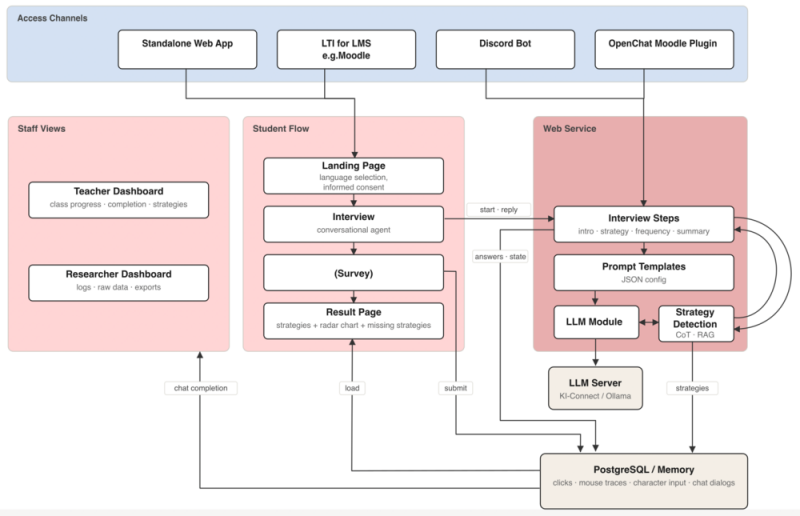 Foto: CATALPA
Ready for a Variety of Applications
To support use in various contexts, SRL-Agent offers several deployment modes: as a standalone web application, as an LTI tool – meaning it can be integrated directly into platforms such as Moodle or Ilias – and as a platform-independent, complete Docker Compose stack for easy operation. Optionally, a Discord integration for notifications can also be enabled.
The required infrastructure scales manageably with the volume of use: For campus-wide deployment with over a hundred concurrent students, the system scales on a relatively small server with 4 GB of RAM and standard CPU capabilities. A separate server for the actual language model is required in any case. In this project, in the spirit of digital sovereignty, we are using the French Mistral-small 119b model provided by KI:connect.
The current version of SRL-Agent also includes a customized version of the SRL-O questionnaire. This makes it possible to triangulate the results of the interview with established questionnaire tools as well as behavioral data from the learning management system.
Scientifically Grounded and Practically Tested
SRL-Agent is not merely a technical project, but is closely integrated with CATALPA’s research on self-regulated learning. The approach of implementing the classic interview protocol by Zimmerman and Martinez-Pons using generative AI has been presented and discussed in several academic publications, including the Journal of Research on Technology in Education, at the International Conference on Education Technology and Computers 2025, and most recently at Learning Analytics & Knowledge 2026.
SRL-Agent was developed by a small, interdisciplinary team: Dr. Niels Seidel (project lead, development/technology), Dr. Slaviša Radović (project lead, SRL expert), Elisabeth Wetchy (developer of the initial prototype), Prasoon Tiwari, and Abdulrouf Emsilkh. SRL-Agent is scheduled to be used in additional courses during the 2026–27 winter semester and subsequently evaluated.
Outlook
Looking ahead, the technical structure of SRL-Agent could also be used for other structured interviews. The team has also applied the concept of collecting qualitative data using agent-based AI to think-aloud protocols. Inspired by an ethics workshop hosted by KI:edu.nrw, the team is also working on an EthicsCompanion, a script-based reflection tool that helps developers and designers of educational technology to specifically reflect on ethical issues early in the development process.
- Demo Application | more
- About the SRL-Agent Project at CATALPA | more
- Project Description on KI:edu.nrw | more
- About Project Lead Niels Seidel | more
- Installation Instructions on GitHub | more
-
- Seidel, N., & Radović , S. (n.d.). Measuring and Promoting Self-Regulation with Agentic AI and Learning Analytics. Companion Proceedings 16th International Conference on Learning Analytics & Knowledge (LAK26).
- Radović, S., Seidel, N., & Wetchy, E. (2025). Implementing the self-regulated learning structured interview protocol with generative AI: A novel approach for evaluating students’ SRL skills. Journal of Research on Technology in Education, 1–18. https://doi.org/10.1080/15391523.2025.2547176

- Radović, S., Wetchy, E., & Seidel, N. (2025). An AI-based Chat Agent for Measuring Students’ Self-Regulated Learning Skills. 2025 International Conference on Education Technology and Computers (ICETC), 169–173. https://doi.org/10.1109/ICETC66579.2025.11387673
- Seidel, N., Wetchy, R., Radović, S., Prasoon, T., & Emsilkh, A. (2026). SRL Agent: Software for Conversational Assessment of Self-Regulated Learning [Computer software]. CATALPA, FernUniversität in Hagen.
- Wetchy, E., Radović, S., & Seidel, N. (2026). Entwicklung und Evaluation eines generativen Gesprächsagenten zur Erfassung selbstregulierten Lernens. 24. Fachtagung Bildungstechnologien (DELFI 2026).
- Wetchy, E. (2024). An AI-Based Chat Agent to Support Students’ Self-Regulated Learning Skills (Ausgezeichnet als Beste Masterarbeit der Fachgruppe Bildungstechnologie der Gesellschaft für Informatik). FernUniversität in Hagen.