


News
Position Paper: AI as a Sociotechnical System – CATALPA Researcher Laura Froehlich Is a Co-Author
[26.10.2026]The Social Psychology Section of the German Psychological Society (DGPs) has published a position paper on the societal implications of artificial intelligence. PD Dr. Laura Froehlich from CATALPA contributed to the paper, drawing on her research on stereotyping and its consequences.
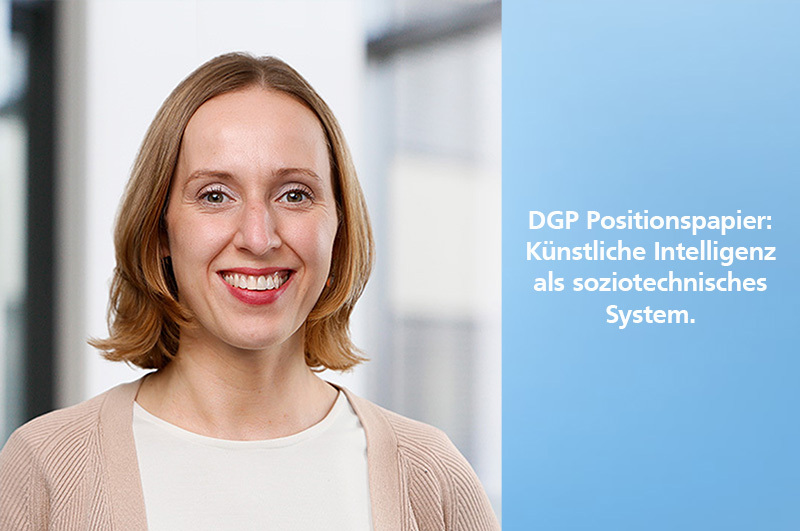
AI applications such as large language models have long been part of our everyday lives: We use them for writing, researching, making decisions, and, increasingly, as conversation partners. But what are the consequences for our social interactions? The position paper “Artificial Intelligence as a Sociotechnical System: A Perspective from the Social Psychology Section,” which was published in “Psychologische Rundschau” (Issue 4/2026). It is part of a special issue in which various sections of the German Psychological Society (DGPs) present their perspectives on AI.
Under the coordination of Prof. Dr. Andreas Glöckner (University of Cologne) and Prof. Dr. Selma C. Rudert (RPTU Kaiserslautern-Landau), 13 researchers from Germany and Austria have compiled the current state of research. Dr. Laura Froehlich from the FernUniversität in Hagen, a researcher at the Faculty of Psychology and the CATALPA Research Center, is among the contributors.
AI Is Not a Neutral Actor
The authors examine three areas: how people perceive AI, how they use AI to make judgments and decisions, and how AI influences group processes and social cohesion. Their conclusion: AI has a social impact. However, the nature of that impact depends on how it is designed, trained, and deployed.
Focus on Stereotypes
One focus of the paper is on stereotypes and discrimination. Large language models are trained on texts written by humans, which means that—without targeted countermeasures—they adopt societal stereotypes and biases. This involves, on the one hand, how groups are portrayed and, on the other hand, whether they are represented sufficiently at all. Countermeasures taken by providers, in turn, can create new biases. It therefore comes down to taking the right measures. However, the paper also highlights opportunities, such as AI-supported contact interventions, which can help break down prejudices between groups.
This is where Laura Froehlich’s research comes in. She investigates how stereotypes arise and function, and what consequences they have for society and learning. As AI is increasingly used in learning and educational contexts, these questions are becoming more important: What images of social groups do AI systems convey, and how do they affect learners?
 Photo: Hardy Welsch
In research on stereotype threat, we will use AI in the future to reduce prejudice and strengthen collaboration. In collaborative writing tasks, for example, AI can detect problems in collaboration. We are investigating how this works reliably and what measures AI can take to best support groups.
PD Dr. Laura Froehlich
Recommendations and Open Questions
The authors derive concrete recommendations from their findings. AI should not replace human relationships but rather complement them and support decision-making – though decisions should ultimately always be made by humans. Before being deployed, AI should also be screened for bias and discrimination and should strengthen social cohesion. The authors also call for greater integration of social-psychological expertise into committees responsible for regulating and shaping AI.
At the same time, they see a great need for research, especially regarding psychological mechanisms and theory development. They consider these six questions to be central:
- What mechanisms cause people to turn away from other people and toward AI?
- Under what conditions does AI have a positive effect on human interactions, and under what conditions is it harmful?
- What mechanisms influence the degree to which people trust AI, and to what extent do these align with the factors that are relevant?
- Under what conditions can AI mitigate stereotypes and group-based discrimination?
- Under what conditions does AI strengthen or weaken trust in institutions, social capital, and collective self-efficacy?
- How do AI-related psychological threat processes affect social interaction and social capital, and how can these dynamics be steered to strengthen social cohesion?
To answer these questions, the authors argue that social psychology should move beyond granular analyses within narrow paradigms and examine broader social contexts. To this end, they recommend collaboration with sociology, law, computer science, communication studies, and economics, as well as with other subfields of psychology.
About the Publication
- Glöckner, A., Diller, S. J., Froehlich, L., Kinskofer, F., Knab, N., Köbis, N., Lermer, E., Oeberst, A., Siem, B., Ventura, A., Watermann, L., Yarza Navarro-Schär, V. G., & Rudert, S. C. (2026). Artificial Intelligence as a Sociotechnical System. A Perspective from the Social Psychology Division. Psychologische Rundschau, 77(4), 216–224. https://doi.org/10.1026/0033-3042/a000780
The article is freely available under an Open Access license (CC BY 4.0).
