


News
Wie lernen Studierende wirklich? Dr. Kamila Misiejuk will es sichtbar machen
[18.11.2026]Dr. Kamila Misiejuk received the FernUniversität’s 2026 Research Award in the Early-Career category. She is conducting research as a postdoc in the “Learning Analytics” research professorship led by Jun.-Prof. Dr. Ioana Jivet. In this interview, she explains how learning processes can be studied using AI and why the order matters.
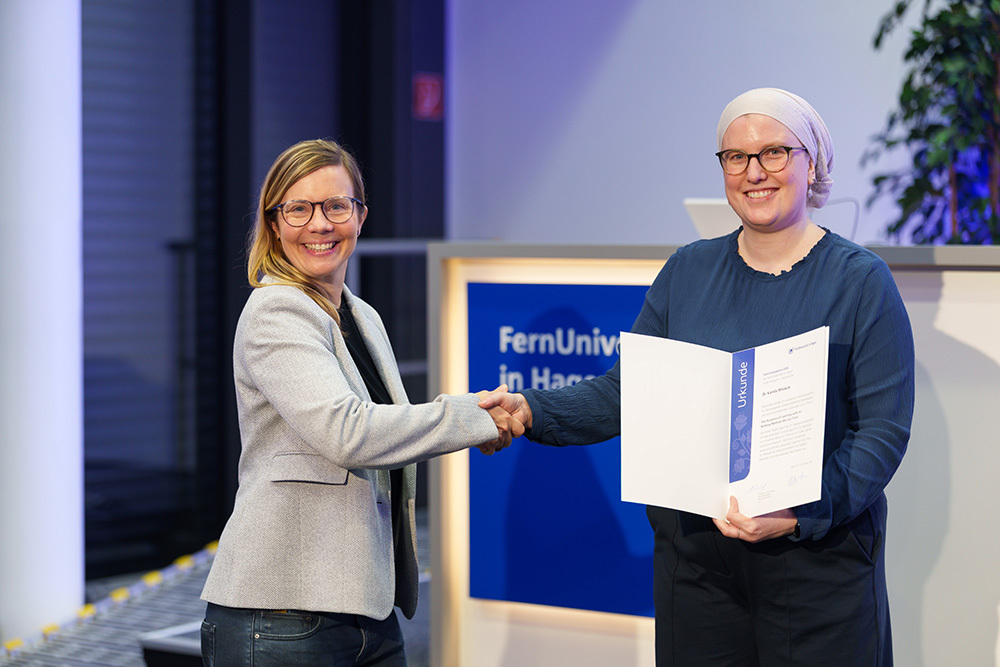 Photo: Volker Wiciok
Kamila, you received the Early-Career Research Award, in part, for pursuing new approaches to the analysis of learning processes. Can you explain a little more about exactly what you’re doing?
I’m developing methods to examine how learning unfolds over time, as well as procedures to ensure that these methods are reliable. A conversation, a study group, or a student’s interaction with an AI tool is a sequence of actions. I make visible which actions occur together and which follow one another.
What does that look like in practice?
It starts with coding: Researchers go through the data step by step and assign appropriate categories to each utterance. For example, if a student writes to the AI, “I don’t understand the second step—can you explain it to me?”, this utterance is assigned two categories: “identifies a gap in understanding” and “asks for help.”
Next, we count how often one category is followed by a specific other category—for example, how often “asks for help” is followed by “checks the answer.” The result is visualized as a network. This shows at a glance which steps frequently follow one another in the interaction between students and the AI. This creates a model of the learning process.
Two things are important to me here. The models must be statistically robust, which can be verified with appropriate tests. And they must remain faithful to the data—that is, provide a reliable picture of what actually happens during the interaction with the AI. That’s why we repeatedly review the original conversations to check whether the model accurately reflects them.
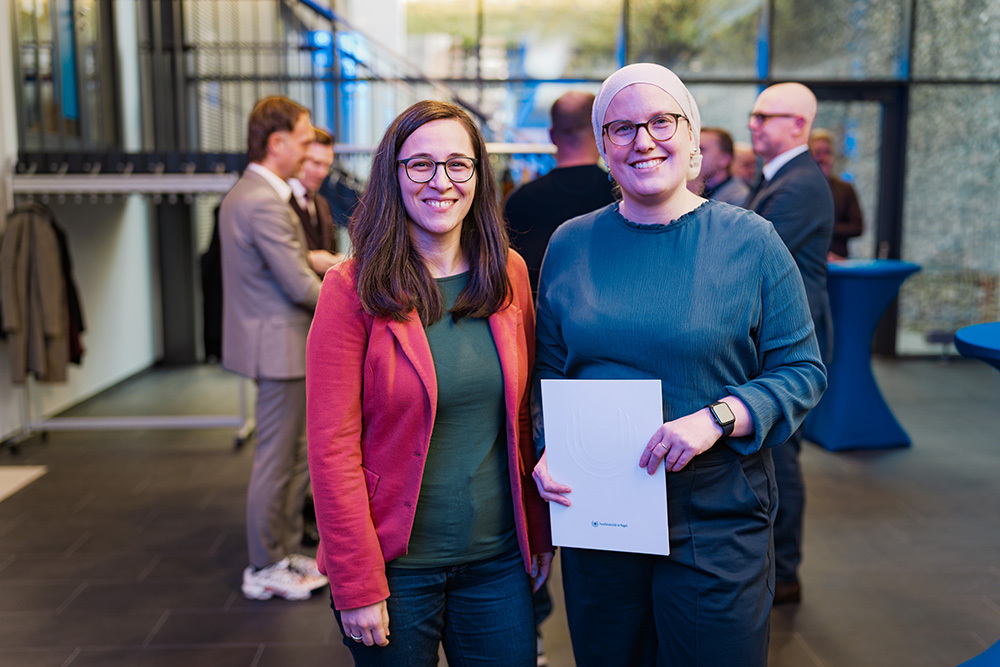 Photo: Volker Wiciok
What is your specific contribution here?
In the coding process. Common measures of agreement among coders only show whether two people assign the same codes. They say nothing about whether they also see the same sequence. For process-based methods, however, the sequence is crucial. I’ve developed a three-step procedure with two new measures. They show, code by code, whether the coders also agree on the sequence.
Today, coding is often handled by language models. Is that a problem?
It can be. My systematic review has shown that while many studies examine the reliability of AI coding, others do so only unsystematically or inadequately. This is particularly problematic when dashboards are created or feedback is provided to students and instructors based on this coding: if the coding is unreliable, so are the dashboards and the feedback. Furthermore, language models show only moderate agreement with human coders on the nuanced, context-dependent categories—and these are often the most important ones. In a recent study, I demonstrate that such coding errors can propagate through automated feedback and distort conclusions about learning.
 Photo: Hardy Welsch
If AI can do the work, we have to ask whether a degree still demonstrates genuine learning. To answer that, we need reliable evidence of how students actually interact with AI.
Dr. Kamila Misiejuk
What insights have you been able to contribute using these methods so far?
A longitudinal study revealed that when students give instructions to an AI, they often outsource the hard thinking instead of deepening their own understanding. The quality of the work depends on how the prompts are phrased. Strong submissions are characterized by coherent, well-embedded prompts, while weaker ones are marked by mere instructions and contradictions. In another study, the use of AI when writing essays did not change grades, but it did alter peer evaluation. The feedback became more vague and lenient. And in a programming course, interaction with ChatGPT was characterized by superficial self-regulation, with little deep reflection or self-assessment.
What do you think this means for learning at universities?
Generative AI has made its way into education in a very short time, often before educators can assess its impact. If students outsource their thinking, AI may undermine the very skills it is meant to foster. If it exacerbates differences among learners, it risks creating greater inequality. And if AI can do the work, we must ask whether a degree still attests to genuine learning. To answer this, we need reliable evidence on how students actually interact with AI.
Why are FernUni and CATALPA good places to research this?
At FernUni, approximately 75,000 students learn primarily online, which offers great potential, especially for learning analytics. In addition, a learning analytics policy governs data collection, which provides a solid framework for research. At the CATALPA Research Center, with its interdisciplinary “real-world lab” approach, I also consistently gain valuable insights from other perspectives and have the opportunity to produce valid results in real-world settings. What’s also important to me personally is the freedom to pursue experimental, methodological projects and to lead my own research.
Are your methods also available to others?
That’s important to me. I contribute to freely available tutorials, help develop and test open-source software such as CarmNote, and teach these methods in workshops and summer schools. Two R packages, Nestimate and cooccure, are available on CRAN.
What are your future plans for research, and how will you use the prize money?
So far, I’ve tested the new measures on simulated data. Now it’s time for real-world coding projects. This will show how the methods work in practice, and we’ll be able to set meaningful thresholds. A diagnostic tool that guides researchers through the process, calculates the measures, and highlights inconsistencies already exists. I would be delighted if other research groups tried it out and shared their experiences. In the long term, I’d like to use this to develop process-based learning indicators, modeling techniques, and practical applications that can be empirically tested. To that end, I plan to apply for larger grants from external funding sources.
I would like to publish my work as open access, present it at conferences, and possibly hire an assistant to help with coding. This will allow us to test the metrics using authentic student data.
