CATALPA Lecture Series: Roland Klemke on Multimodal Immersive Learning Systems
[13.03.2026]
Multimodal Immersive Learning Systems - Technologies for cognitive, affective, and psychomotor learning support: This was the topic of the third edition of the CATALPA Lecture Series with Prof. Dr. Roland Klemke in the Immersive Collaboration Hub (ICH) at FernUni.
Photo: CATALPA
Prof. Dr. Marcus Specht (right) and Prof. Dr. Roland Klemke at the lecture.
Insights into science from international colleagues and opportunities for exchange – that's the goal of the CATALPA Lecture Series with guests like Prof. Dr. Roland Klemke. He deals with multimodal immersive learning systems.
Many educational technologies have their main focus on cognitive aspects of learning: content delivery, assignments, assessments, and communication are often used instruments. Aspects of affective and psychomotor learning are less often addressed. Recent advances in artificial intelligence, sensors, multimodal interaction, and immersive environments allow to revise this: affective states of learners and their psychomotor activities can be monitored and analysed. Data collected and insights gathered thereof can be embedded in the learning process with automated feedback or guidance.
However, using such a complex combination of technologies to design effective and usable learning situations is challenging:
Photo: CATALPA
Warm welcome at CATALPA: Prof. Dr. Marcus Specht and Prof. Dr. Roland Klemke.
How do we design immersive learning environments to be engaging and effective, safe and enjoyable?
Which sensor technologies are useful to capture student data? Which sensors provide accuracy without being intrusive?
How to collect reliable and usable data for machine learning approaches in sufficient quality and quantity? How do machine learning models have to be designed and trained to react to student activities properly?
When and how should we provide feedback without causing distraction or increasing cognitive load?
How do we responsibly deal with sensitive student data captured during these processes?
In his talk Klemke presented concepts and results from several research projects dealing with these questions and how approaches of multidisciplinary research have been applied. The researcher presented examples of results from a wide variety of projects, such as a table tennis tutor, a face game, and an AR robotic gameplay, as well as a project on immersive tutoring.
About Prof. Klemke:
Roland Klemke is professor for Technology-enhanced Learning and Innovation at the Research and Innovation Center for Open Distance Education (ECO Lab) of the Open University of the Netherlands. He leads national and international research projects in the TEL field. Research topics include artificial intelligence for education, multimodal learning experiences, augmented- and mixed-reality, multi-sensor architectures, serious gaming, game-based learning, gamification, and mobile learning.
Next lecture in the series with Prof. Dr. Tamara van Gog
The next date for the lecture series has already been set and can be noted in your calendar: On May 7, 2026, starting at 4 p.m., Prof. Dr. Tamara van Gog will give a lecture. She is a long-standing member of the CATALPA Advisory Board and holds the Chair of Educational Sciences at Utrecht University.
Roland Klemke also holds a professorship for game informatics at the Cologne Game Lab, TH Köln, Cologne, Germany, where he teaches and researches subjects like artificial intelligence, game engine architectures, game development methodologies, game physics, and serious games. Additionally, he is CEO of Humance AG, a Cologne based software development company specialized in mobile and web-based solutions, coordinating research and development activities.
Until 2018, Roland worked as professor for game design at Mediadesign Hochschule (Mediadesign university of applied science) in Düsseldorf, Germany. Until 2002 he contributed as scientist at Fraunhofer Gesellschaft to national and international research projects. He received his degree in Computer Science in 1997 from University of Kaiserslautern and a doctoral degree from RWTH Aachen in 2002. Roland is vice-president of the European Association for Technology-Enhanced Learning (EATEL), member of Gesellschaft für Informatik (GI), fellow of the Interuniversity Center for Educational Sciences (ICO) and fellow of the Dutch research school information and knowledge systems (SIKS).


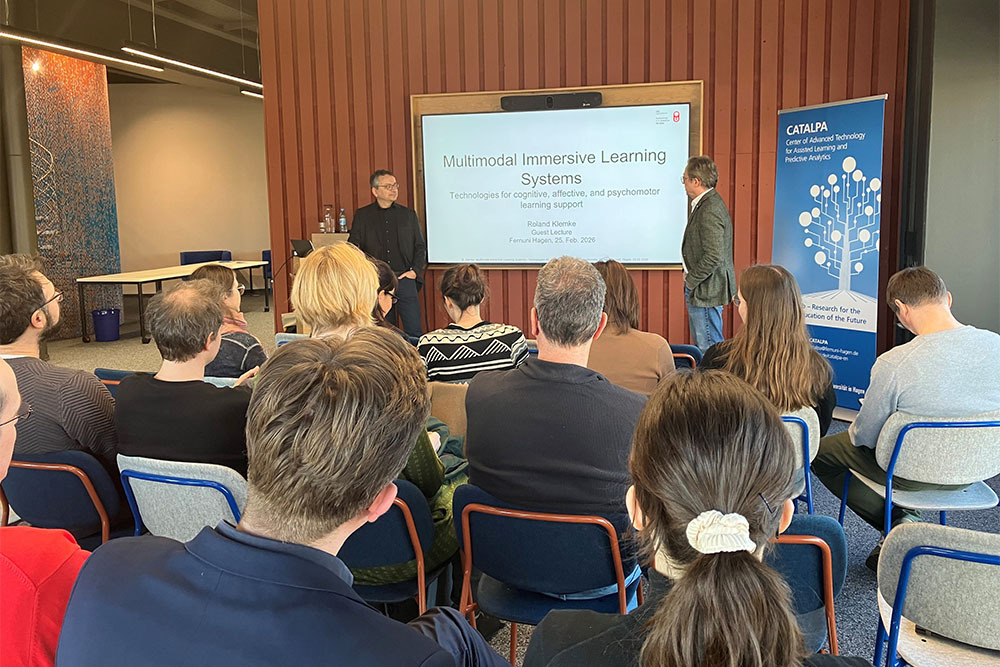 Photo: CATALPA
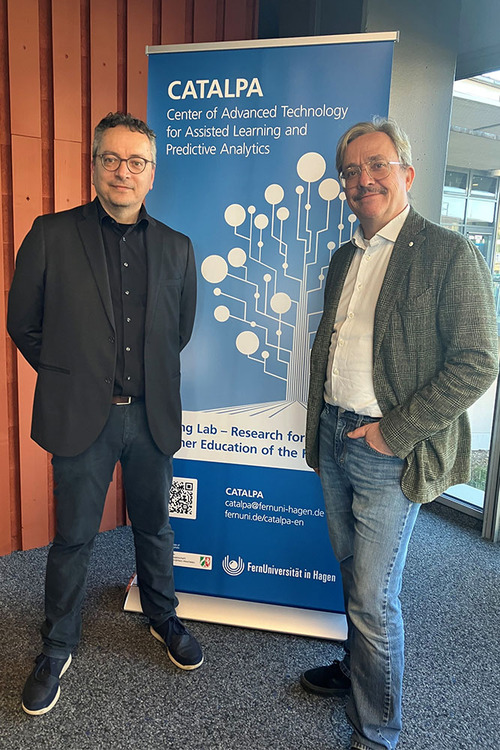 Photo: CATALPA