


News
CATALPA Lecture Series with Tamara van Gog
[03.06.2026]How can self-directed learning be fostered in online learning settings? This was the focus of a presentation by CATALPA Advisory Board member Tamara van Gog of Utrecht University on May 7.
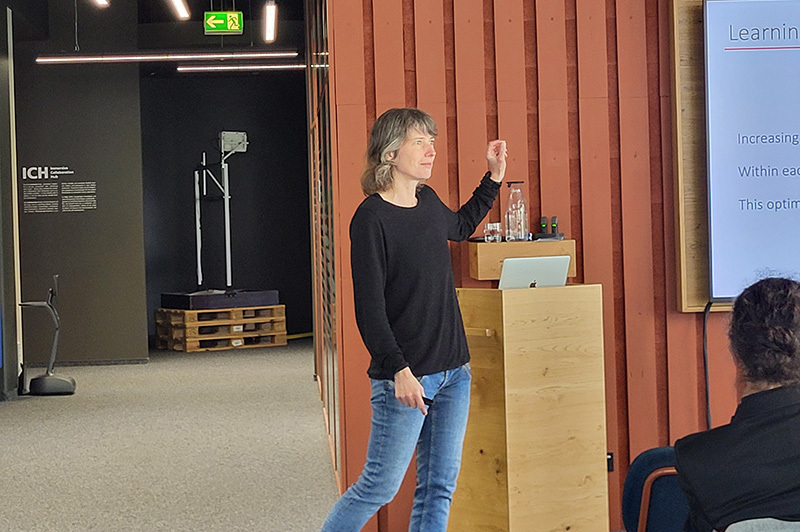 Photo: CATALPA
The CATALPA Lecture Series was back for another round. This time, Tamara van Gog discussed the skills needed for self-regulated learning.
Calibrated and In Control: Fostering Self-Regulated Learning with Problem-Solving Tasks in Online Learning Environments
"Most of the textbook exercises we have today aren't very well suited for self-regulated learning," is one of Tamara van Gog's opening statements. What the researcher from the Netherlands means by this is that textbooks and exercises are designed in such a way that a teacher is always needed. Self-regulated learning, however, is an important skill and a cornerstone of our learning—throughout our entire lives. So how can this be supported? In this lecture, Tamara van Gog first addressed the critical role of the accuracy of (self-)monitoring and (self-)regulation/control processes for effective self-regulated learning. Subsequently, she presented research from her team on training students’ self-assessment and task-selection skills as a means to improving self-regulated learning with problem-solving tasks (as commonly found in STEM-domains) in online learning environments. This training approach united principles from example-based/social learning, cognitive load theory, the 4 component instructional design model, and adaptive instruction.
Afterwards she discussed with the audience whether and how these principles might also be useful in (research on) the FernUni study programs.
Take home message 1: Feedback is important for self-directed learning
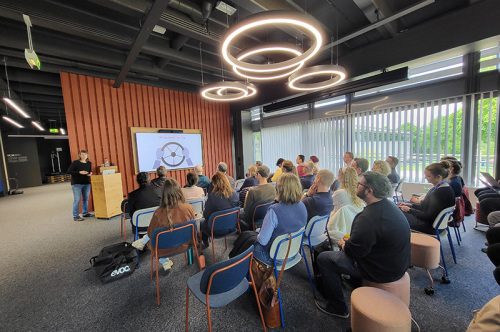 Photo: CATALPA
Self-regulated learning can be supported by training learners to assess their own performance and, based on that assessment, select an appropriate next task. In this process, the level of support provided for completing the task gradually decreases as performance on the previous task improves. Of course, this requires appropriate feedback on assessment and performance. However...
Take home message 2: Feedback can backfire
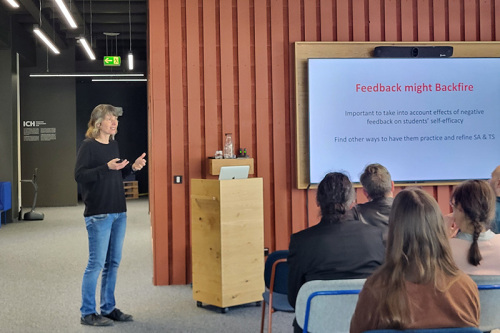 Photo: CATALPA
... Negative feedback can affect self-efficacy and, as a result, the ability to assess oneself accurately. This, in turn, is an important skill for self-regulated learning. Therefore, other ways must be found to develop the ability to assess oneself.
About Tamara van Gog
Prof. Dr. Tamara von Gog is Professor for Social and Behavioural Sciences at the University of Utrecht. Her research on learning and instruction focuses on example-based learning; multimedia learning; and (training) self-regulated learning, reflection, and critical thinking skills. Her research is conducted at all levels of education as well as with medical doctors (in training). She often uses eye tracking in her research and has investigated innovative techniques for using eye tracking as a tool both to study and enhance learning processes.
