


News
CATALPA Doctoral candidates 2025
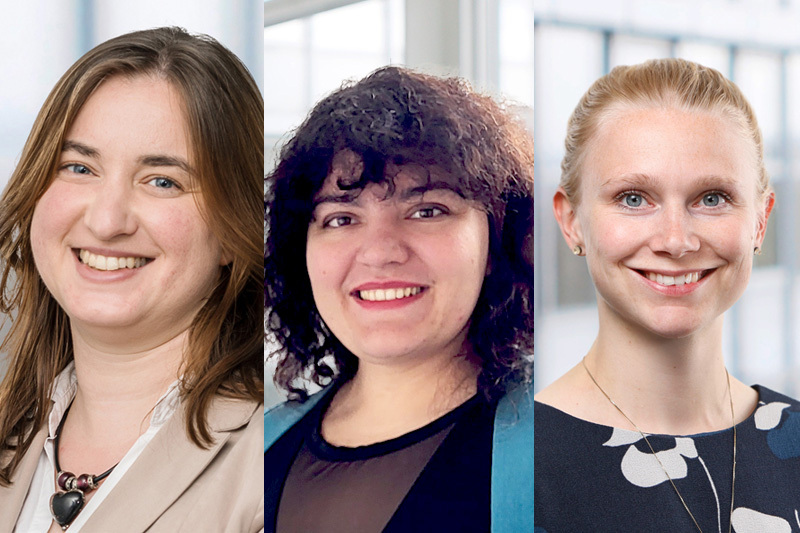
[05.11.2025]This year, Franziska Wehrhahn, Nathalie Bick, Regina Kasakowskij, and Judith Preuß completed their doctorates at CATALPA or in an associated project. The researchers will remain at the research center in various positions or at least maintain close ties with it. CATALPA would like to congratulate them once again on their degrees and look back on their achievements.
Franziska Wehrhahn: Lieber autonom lernen oder mit leitender Unterstützung?
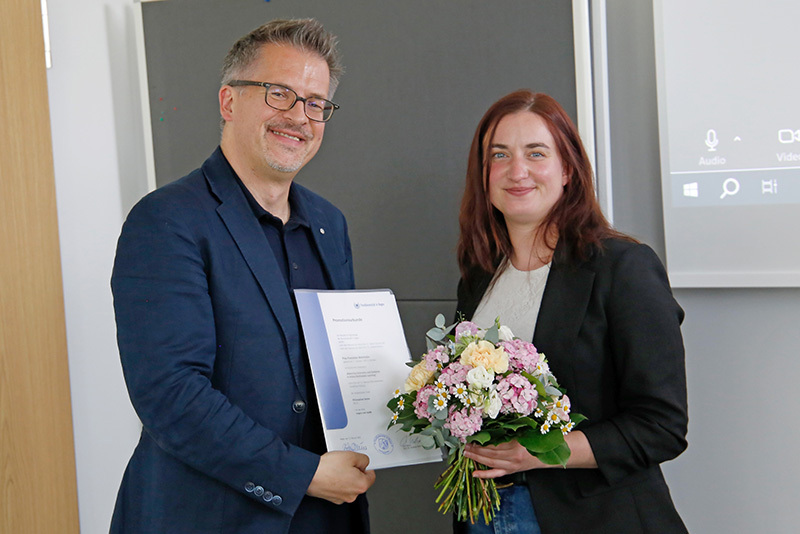 Photo: FernUni
Using media can support learning. But how exactly? For her dissertation, CATALPA researcher Franziska Wehrhahn examined various learning settings in detail.
Wehrhahn herself studied at FernUni, completing her Master's degree in Educational Sciences in 2021. “Even back then, I noticed that we students had very different approaches to learning,” she says. "I found that very exciting." In the CATALPA junior research group Multimedia, led by PD Dr Fang Zhao, she had the opportunity to examine this topic in more detail from a psychological perspective.
Students want choices
How much autonomy do students want when learning online? To what extent can guidance be helpful? These were two central questions in Franziska Wehrhahn's dissertation. She approached these questions from different perspectives in three studies. Two of these studies took place in a real psychology course, i.e. under real-world conditions. For instance, she first asked the students about their preferences. Did they prefer clear guidelines for online learning or did they appreciate the freedom to decide what content to study and when? She found that 59 per cent of students wanted the freedom to make their own decisions. However, preferences and behaviour do not always coincide.
Preferences and behaviour not congruent
In a real course, on the other hand, there are structured guidelines. Students are expected to work through the new content in stages. First, they take a pre-quiz to test their prior knowledge. Then, they watch an instructional video and take another quiz. However, students are not required to adhere to these guidelines; for example, they can skip the instructional video and go straight to the post-quiz. Nevertheless, around three-quarters of students largely adhere to the guidelines. 'This means that preferences and actual behaviour are not necessarily the same,' explains Franziska Wehrhahn.
Even after completing her doctorate, Franziska Wehrhahn remained involved in CATALPA's real-world laboratory research. She moved to DIE (the German Institute for Adult Education), a cooperation partner of FernUni, to work with FernUni Rector Prof. Dr. Stefan Stürmer and Prof. Dr. Hannes Schröter on the NOVA:ea project, which focuses on student-friendly e-assessments. On 1 January 2026, she returned to FernUni as part of the 'LEAD:FUH – Learning Empowerment through Analytics and Data' team. The project aims to establish a new cross-faculty teaching architecture at FernUniversität in Hagen. It is designed to offer personalised learning content and support self-regulated learning. “I am very much looking forward to the new task,” says Franziska Wehrhahn. 'It offers yet another new perspective on the topic of learning, which I find extremely exciting.'
Nathalie Bick: How do negative stereotypes affect learners, and who is actually affected?
 Photo: CATALPA
Nathalie Bick also examined learners from a psychological perspective in her dissertation. As a social psychologist, she focuses on student groups. The basic idea: It is widely recognized that there are groups of people who are disadvantaged in the educational system. But are they really just the “usual suspects”? Or are there other groups at risk? Is this disadvantage linked to negative stereotypes? And what consequences do (negative) stereotypes have for those who stereotype and those who are stereotyped? And how does this manifest itself in distance learning? Nathalie Bick worked on the answers to these questions in her doctoral thesis.
Sense of belonging at risk
In her work, she studied distance learning students to shed light on distance learning and its strengths and challenges. She found that one's own social identity plays a role in distance learning. Students with chronic illnesses or disabilities, with children, with jobs, or with a different native language are particularly afraid of confirming stereotypes about their respective groups. Nathalie Bick also showed that this fear was linked to a lower sense of belonging to the FernUni and that students with such concerns were less likely to approach their fellow students.
How can we support students?
“We are now focusing on the question of whether and how we can support students with different group affiliations in their distance learning,” explains Bick. During her doctoral studies, Nathalie Bick visited Cornell University's Future of Learning Lab and prepared studies and experiments that address precisely this issue. She is now continuing her work in the CATALPA research group Stereotype Threat and is working, for example, on interventions designed to help student groups who experience discrimination and want support. “We are currently planning new projects that will zoom in more closely on the various student groups and examine the possibilities of social-psychological interventions both within and outside the FernUni context,” she says.
Regina Kasakowskij: Bidirectional feedback processes
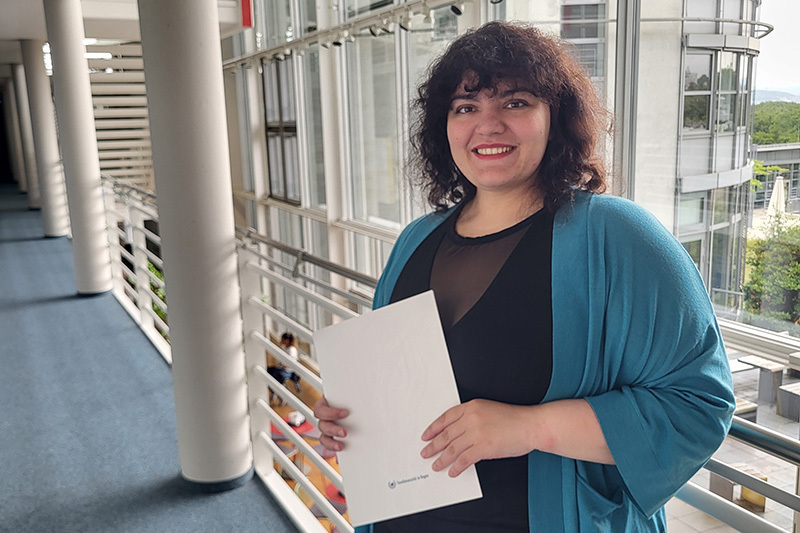 Photo: CATALPA
In her dissertation, Regina Kasakowskij examined feedback processes from an IT perspective. She developed a system that automatically generates and provides feedback for specific exercises – known as self-assessments – and offers the option of evaluating the automatic feedback. What makes this system special is that the researcher considers feedback processes to be bidirectional, i.e., from teachers to students, but also vice versa. Teachers provide evaluation criteria on the one hand and appropriate feedback for fulfilling the criteria on the other. Depending on which of these criteria a task solution meets after self-assessment by the students, they automatically receive the appropriate feedback. The students, in turn, can then provide feedback on whether this feedback was helpful to them or where they might want a more understandable explanation. This enables improvement in both directions.
Students and teachers endorse bidirectional feedback
“This was well received by both students and teachers,” reports Kasakowskij. Students received timely and detailed feedback on individual task steps. Because they were able to provide feedback on how helpful it was for them, teachers had the opportunity to adapt the learning material to the actual needs of the learners and to change it if necessary.
AI-generated tasks
Regina Kasakowskij also remained loyal to CATALPA after completing her doctorate: she is conducting research in the twin projects METALADIN and Aiducator. “Actually, it's a great fit,” she says. METALADIN, short for “Meta-Generator for Tasks and Solutions (Help) from Computer Science and Related Disciplines,” is about AI-generated tasks and the selection of tailor-made task sequences for students. The goal is to develop a software product that offers personalized, iterative practice opportunities for competency-based tasks. The Aiducator project deals with feedback. The researchers have set themselves the goal of generating personalized feedback in real time and tailoring it to the individual needs of learners, such as media preference, language, or learning level. Regina Kasakowskij recently presented the initial results at the Innovating Higher Education Conference in Hagen. Among other things, the researchers tested various large language models for feedback. “Overall, the AI-generated feedback proved to be accurate, relevant, and logical,” she says. “The results are very promising.”
Summa cum laude for Judith Preuß
 Foto: CATALPA
Judith Sarah Preuß schloss am 4. November ihre Promotion mit Summa cum laude am Lehrgebiet Bildungspsychologie ab. Ihre Dissertation schrieb sie im bei CATALPA assoziierten Projekt InterMINT mit dem Thema: "International Students in Germany. Psychological Study Success Factors in STEM versus Non-STEM subjects from an intersectional perspective."
