


News
How Is Artificial Intelligence Changing the University as an Organization?
[10.07.2026]Generative AI has quickly made its way into lectures, seminars, and administrative offices – but what does this actually mean for higher education? The CATALPA research project AIM-HE is exploring this question. Dr. Len-Ole Schäfer and Tiana Tschache provide insights into the project.
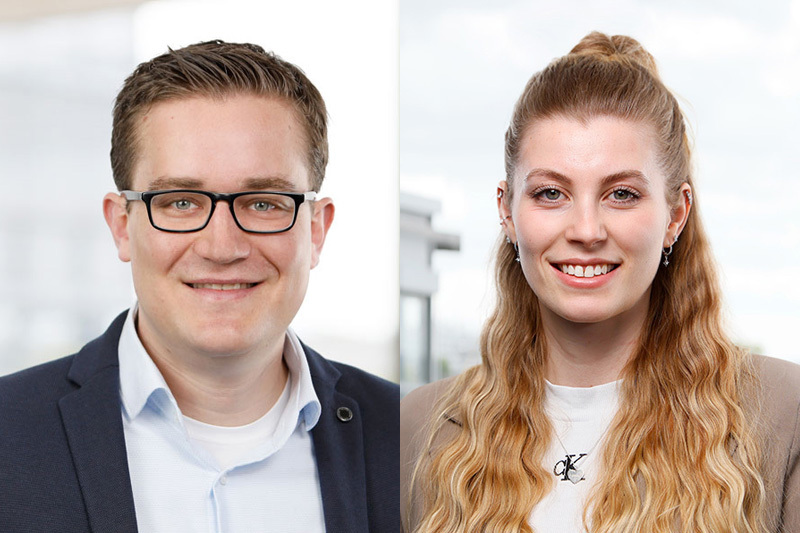 Photo: Hardy Welsch
The focus of AIM-HE (Artificial Intelligence: Multilevel Studies in Higher Education) is not on individual AI applications, but rather on the interplay between the various levels of a university: from individual faculty members to university leadership.
Sociological Questions About AI
“With AIM-HE, we are examining the use of AI technologies at universities from an organizational sociology perspective,” explains project leader Len Ole Schäfer. The central question is: How are the individual levels of a university interconnected when it comes to the use of AI? What role do management levels, leadership, and formal and informal structures play – and what influence do motivations, collaborations with other universities, or the characteristics of the AI technologies themselves have?
The project’s roots lie in a fundamental question of sociology: the relationship between the micro and macro levels – that is, between the individual and the structure. “AIM-HE explores how these are connected. Here, the university as an organization plays a central role,” says Schäfer. AI technologies open up new perspectives on these questions – while at the same time presenting the research team with unique methodological challenges.
How do universities manage to remain resilient in times of crisis? The key, above all, is reflection. This is the finding of research from the completed “ORC” project led by Dr. Len-Ole Schäfer in collaboration with the Alexander von Humboldt Institute for Internet and Society. The Higher Education Forum on Digitalization (HFD) is currently presenting these findings in a blog post. With the practical “Learn-and-Do” kit, universities can better position themselves here.
Literature Review, Concepts, and a Look at AI Governance
The project is currently in a conceptual phase: The team is conducting literature reviews and developing theoretical foundations for the governance of artificial intelligence at universities. The starting point remains the interconnection between individuals and structures. This is expanded to include the perspective of AI – both conceptually and empirically.
What's new about this approach: AIM-HE links questions from the sociology of organizations with current societal developments surrounding artificial intelligence. “Another new aspect is that we view AI not only as an innovative tool used primarily in teaching, but also in terms of how AI is changing – or has the potential to change – fundamental organizational structures at multiple levels of the university,” emphasizes Schäfer.
On Motivation and Ethical Reflection
Classic sociological questions – such as the emergence of social order, stability and emergence (the emergence of new properties), the causes of social inequality, and how norms, values, and institutions shape human action and, consequently, structures – are taking on new relevance in the age of artificial intelligence. It is precisely this area of tension that serves as the motivation for Len Ole Schäfer and his team’s project. The aim is not only to explore the potential of AI in the higher education context but also to stimulate reflection on the ethical use of the technology.
The researchers hope this will lead to concrete practical outcomes: universities should be able to reflect more consciously on the use of AI technologies and their interactions. Planning, oversight, and the degree of autonomy granted to AI technologies all play a central role in this process.
From Research Assistant to Ph.D. Candidate: Tiana Tschache's Journey to CATALPA
Tiana Tschache, a Ph.D. candidate at AIM-HE, is part of the team. She has been familiar with CATALPA for some time and previously worked on the predecessor project, ORC, while she was a student. “I’ve felt very comfortable at CATALPA ever since I started my position as a research assistant. Working on the OrA and ORC projects has really shaped and inspired me as a young researcher.” She particularly appreciated the supportive work environment in the research team from the very beginning – and ultimately, it inspired not only the topic of her master’s thesis but also her decision to pursue a Ph.D. “So, of course, CATALPA was at the top of my list.”
What particulary appeals to her about AIM-HE is the thematic diversity and the focus on a highly topical subject. “I find it fascinating to explore the interplay between individual attitudes, organizational structures, and technological innovations, and to understand how universities, as organizations, deal with these changes.” She is particularly interested in how universities cope with uncertainty and change, how innovation processes are shaped, and what role different stakeholders play in shaping digital transformations.
