


News
Judith Preuß: "I really enjoy data jumble"
[05.02.2026]Judith Preuß's unique educational path led her from hotel reception to campus. Accordingly, her doctoral thesis examines what good study conditions are - regardless of one's background. The InterMINT project associated with CATALPA was a central component of her doctoral thesis.
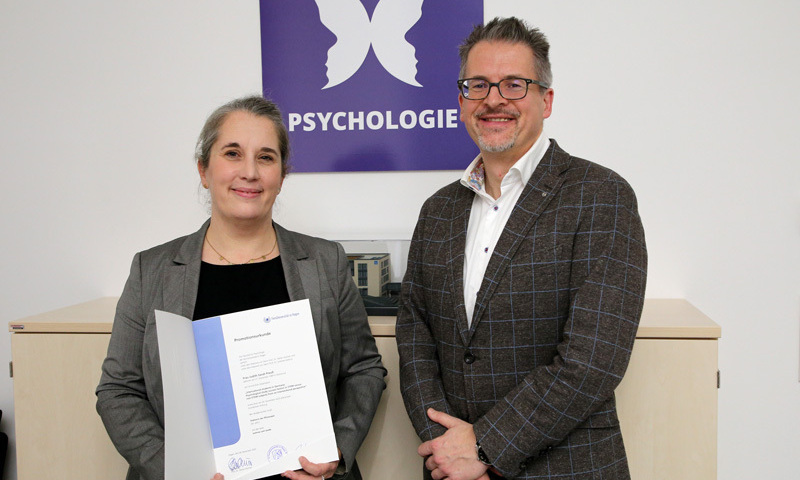
 Photo: FernUniversität
"I really like the dual nature of my job," says Dr. Preuß, referring to her duties as a scientist in research and teaching. The psychologist has now completed her doctorate at FernUniversität with summa cum laude honors. Twenty years ago, she certainly would not have guessed that she would one day be a researcher in Hagen. In line with FernUniversität's tradition, her career path initially took her in a direction completely unrelated to academia. After training as a hotel manager, she worked at the reception desk and in the personnel office of the Mövenpick Hotel in Essen. She was the deputy restaurant manager at the Dortmund Golf Club. Finally, after further training, she became a branch manager at Tchibo. During her first parental leave with her son from 2009 to 2012, she first came into contact with FernUniversität: "I just took a look — and started studying psychology," Preuß recalls. As a mother of a young child, FernUni's flexible study model was perfect for her when she returned to Tchibo. "Hence, I stayed."
Seamless Transition to a Scientific Career
Between 2013 and 2016, Preuß took a second period of parental leave with her daughter. With a bachelor's degree in psychology, she reoriented herself in 2017, beginning work as a student assistant at the Federal Institute for Occupational Safety and Health (BAuA). "I did data preparation in the project of working time reporting for Germany and realized that I really enjoy statistics and all that stuff – not just the practical application of psychology." However, with two young children, the presence-oriented workday at the Federal Institute proved complicated. She had to make new plans: full steam ahead toward a master's degree in psychology at FernUni. In 2018, she began working as a student assistant in educational psychology. "I saw the job posting for Dr. Julia Zimmermann's 'Campus International' project and applied."
She was given increasingly important tasks in the research project and its follow-up projects, such as preparing data, writing final reports, and editing. "I just really enjoy research," says Preuß, "in particular the 'data jumble,' i.e., processing and analyzing complex data sets." After completing her master's degree in 2021, she made a seamless transition into the world of science with a position as a doctoral candidate in Prof. Dr. Kathrin Jonkmann's department. "One thing led to another, even though I wasn't actively pursuing a doctorate at first," says the psychologist with a smile. However, the doctoral position in Dr. Julia Zimmermann's InterMINT project was thematically related to her work as a student assistant. She feels right at home between research and teaching. "I just always followed my heart and my family circumstances," she says.
 Foto: golero/E+/Getty Images
Research Revolved around InterMINT
After around 15 years of distance learning experience, she finally earned her doctorate. What was her research about? "The common thread is the InterMINT project – 'International Students in Germany,'" explains Judith Preuß. "It was funded by the Federal Ministry of Education and Research (BMBF) as part of the 'Study Success and Dropout II (German)' funding line, which aims to identify and mitigate the reasons for the shortage of skilled workers while students are still in college." The central question is, "What interventions can be used to guide international students through their studies in Germany – and, ideally, encourage them to stay and work here?" The underlying dataset was created as part of the predecessor project, "Success and withdrawal of international students in Germany (SeSaBa/German)," which was also funded by the BMBF. InterMINT was associated with CATALPA – Center of Advanced Technology for Assisted Learning and Predictive Analytics at FernUni, among others. Dr. Julia Zimmermann led both projects and supervised Judith Preuß's successful doctoral thesis together with Prof. Dr. Kathrin Jonkmann.
"I still remember very well the challenges you often face as a distance learning student with a job and a family."
Judith Preuß
Considering Individual Circumstances
In line with her research on study conditions for a diverse student body, Preuß believes it is important to teach in a way that considers her students' individual circumstances and to be empathetic when someone is in a bind due to time constraints, for example. "Sometimes I offer counseling sessions later in the evening," Preuß says. "I still remember very well the challenges you often face as a distance learning student with a job and a family."
Campus International
Even after completing her doctorate, Preuß is staying in Hagen. Since October 2025, she has been working on the fourth edition of Dr. Julia Zimmermann's DAAD project, Campus International, in addition to her teaching duties. In other words, she is back working on the project that marked the beginning of her career at FernUni. "It's come full circle." The position runs until summer 2026. And after that? " Somehow, things always work out; you just have to keep at it," laughs Preuß. "I think I'm a pretty good example of lifelong learning." One thing is certain for her: "If I'm allowed to stay and our funding continues, I'd be happy to remain at FernUni – that would be like winning the lottery.
