


News
Marcus Specht Appointed New Scientific Director of CATALPA
[15.01.2026]Change at the top of CATALPA: Prof. Dr. Marcus Specht recently took over as the research center's new Scientific Director.
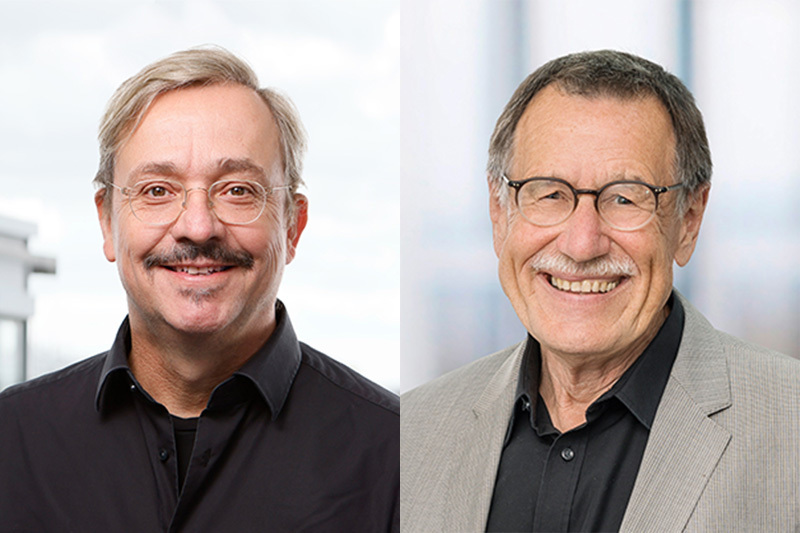 Photo: Hardy Welsch/Henrik Schipper
Specht succeeded Prof. Dr. Dr. Friedrich W. Hesse on January 1. Hesse established the Center of Advanced Technology for Assisted Learning and Predictive Analytics and led it until the end of 2025. Around 60 scientists from the fields of psychology, computational linguistics, educational science, organizational sociology, and computer science conduct research at CATALPA's central facility in Hagen. Using the living-lab principle, they investigate questions relating to the improvement of higher education. "At CATALPA, we have ideal conditions for interdisciplinary research in learning engineering with AI, learning analytics, and other educational technologies," Specht says. "I look forward to advancing this field of research together with national and international partners."
Learning Engineering in the Living-Lab
CATALPA operates as a living lab according to the "learning engineering" methodology. This means that the effects and potential of AI and other educational technologies are first researched interdisciplinarily in a protected environment. Then, proven prototypes are transferred to regular operation at FernUniversität, which has around 80,000 students, through iterative processes.
Since early 2025, Marcus Specht has held the CATALPA research professorship, "Learning Sciences in Higher Education," where he conducts research on the psychology of digital teaching and learning. Prior to that, he supported CATALPA for several years as a member of the Scientific Advisory Board. The previous Scientific Director, Prof. Dr. Dr. Friedrich W. Hesse, particularly values his successor's expertise in several disciplines: "Marcus Specht studied psychology, but he also has a high level of expertise in computer science," Hesse says. "This interdisciplinary approach is a perfect fit for CATALPA."
Combining Psychology and Computer Science
Specht has always been fascinated by the connection between psychology and computer science: Even before beginning his studies, he was interested in intelligent tutorial systems that provide individualized guidance to learners. During his second semester, he took the course "AI for Psychologists" and studied programming languages. "That had a big impact on me," says Specht.
He has since held various positions in both fields, primarily in the Netherlands. Among other things, he was Scientific Director at the Leiden-Delft-Erasmus Centre for Education and Learning. In addition to his research professorship at CATALPA, he currently maintains a chair in Digital Education at the Faculty of Electrical Engineering, Mathematics, and Computer Science (EEMCS) at TU Delft.
 Photo: Volker Wiciok
I am interested in successfully integrating technology to support human learning processes. CATALPA has the ideal conditions for this research.
Prof. Dr. Marcus Specht
Close Integration of Theory and Practice
"I am interested in successfully integrating technology to support human learning processes," says Specht. "CATALPA has the ideal conditions for this research." At the FernUniversität in Hagen, digital teaching and learning have long been standard practice. Thanks to a learning analytics policy, a structured analysis of pseudonymized learning data is possible. These are both important prerequisites for researching digitally supported learning processes in a natural setting.
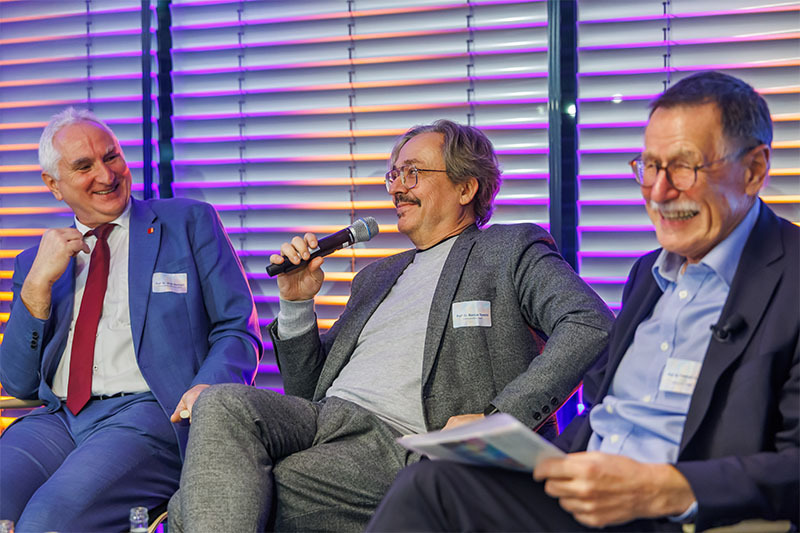 Photo: Thomas Rosenthal
"My predecessor, Friedrich Hesse, laid important foundations by setting up this living-lab," says Specht. "Our research focuses on questions related to the future of higher education." Specht intends to maintain this focus by publishing high-quality articles in top journals and transferring scalable research results to the higher education world. "This is in line with the Leibniz motto, 'Theoria cum praxi,' which emphasizes the close interlinking of theory and practice." Specht is organizing the 2027 Education Policy Forum for the Leibniz Research Network on Education Potential (LERN), of which CATALPA recently became a member.
Hesse Continues to Support CATALPA
The former Scientific Director of the Leibniz-Institut für Wissensmedien (IWM) and former Vice President of the Leibniz Association will remain with the research center as its founding director until the end of September 2026. "The main focus here is on networking," says Hesse. "The research center has built a reputation for excellence and expertise in recent years. We will now continue to expand this together."
- Personal Page Marcus Specht | more
- Personal Page Friedrich W. Hesse | more
- Research Professorship "Learning Sciences in Higher Education" | more
