


News
"How do we shape responsible innovation?"
[18.12.2025]In a double interview, computer scientist Prof. Lena Oden and psychologist Prof. Marcus Specht discuss high-performance computing, learning research in living labs, and responsibility.
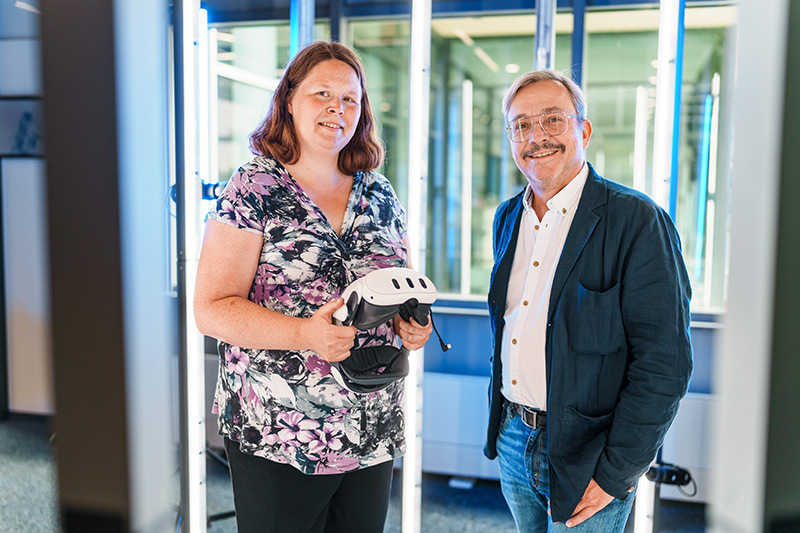 Photo: Volker Wiciok
A new supercomputer, the fastest in Europe; a new version of ChatGPT with fewer hallucinations - technologies are advancing rapidly. In this interview, Prof. Oden and Prof. Specht discuss what this means for research and teaching, as well as how these technologies can be used sensibly and responsibly.
What are you currently researching?
Lena Oden: I am a computer architect by training, so high-performance computing is my background. I study programming languages that can effectively utilize high-performance computers, runtime systems, and novel computing architectures. I also have one foot in the research center in Jülich. In the EBRAINS 2.0 project, which involves setting up a research infrastructure for digital brain research, I am responsible for integrating the computing infrastructure. I help neuroscientists use high-performance computers and neuromorphic systems.
Marcus Specht: I focus on how we can use new technologies and media to support teaching and learning. I deal with the design of these technologies and media as well as impact research. What works, when, and why? We explore these questions at the CATALPA research center. My research is therefore always interdisciplinary. We collaborate with scientists from computer science, psychology, computational linguistics, educational science, and organizational sociology. According to the living lab principle, we conduct research on technical and didactic developments directly within the FernUni's practices and then apply the results to university operations.
 Photo: Volker Wiciok
About the person: Prof. Dr. Lena Oden
Prof. Dr. Lena Oden is the head of the Technical Computer Science department. She researches modern computer architectures. Her focus is on high-performance computing, its applications, programming methods, and runtime systems.
Are there any interfaces or points of contact in your research?
Specht: I previously worked at Delft University of Technology. At the Quantum Computing Center, new programming frameworks are being developed for quantum computers. User interfaces and explanations are also being created so that laypeople can understand quantum computers.
Oden: That's quite close to my work. I like hardware, and I like getting into the details. However, I also work interdisciplinarily. Neuroscientists need to be able to use the hardware, which is not always easy. Neuromorphic systems, for example, are a different type of computing that works more like the human brain. I try to make that concept understandable to people. There are probably points of contact there.
Specht: So, if I understand you correctly, the hardware in neuromorphic systems is closer to the human brain model than classic large language models.
Oden: Yes, significantly closer. However, the latter help more in understanding the functionality of the human brain. Currently, classic large language models on conventional hardware are more powerful than systems that resemble the human brain in structure.
 Photo: Volker Wiciok
About the person: Prof. Dr. Marcus Specht
The psychologist heads the Learning Sciences in Higher Education research professorship at the CATALPA research center. Specht is a member of the research center's management team and develops methods and procedures that support teachers and learners in using generative AI.
Therefore, large language models will likely remain omnipresent in the future. What does that mean for teaching and research?
Specht: If you treat the information they provide critically, they are very powerful tools. I am particularly interested in how they affect the human learning process. In my view, this aspect of the process is often not considered in the development of large language models or AI models. The main focus is on optimizing performance. The effect of the model in a human usage context is rarely researched. This is a general problem in teaching and learning research. Currently, there is a lot of hype surrounding the idea that the next five versions of ChatGPT will solve everything and usher in AGI (Artificial General Intelligence). I would be interested to hear your opinion on this. What do you think?
Oden: "I believe it will transform our daily work lives, teaching, and learning. Other skills will become more important. I think they are very powerful tools. However, I don't believe they will become all-powerful. I think humans will continue to be important interfaces. However, there will be a major change in the next few years. The question is how to teach people to use them responsibly and ensure they don't become too lazy to think for themselves. For me, the biggest challenge in the coming years will be designing my teaching so that people still learn to think for themselves.
The question is how to teach people to use AI responsibly and ensure they don't become too lazy to think for themselves.
Prof. Dr. Lena Oden
Should everything that is technically possible be implemented?
Oden: I always find it difficult to say where the line should be drawn. I have to ask myself: What is just my personal aversion, and what is actually problematic? Simplification is good, for example, but learners shouldn't be exempt from every challenge. I think it's important to encourage thinking and learning
Specht: Well, I'm a bit torn. Innovation is often technology-driven. Then, people are quick to say, 'Social media is addictive, so let's get rid of it.' I think that's dangerous because it stifles discussion. In the Netherlands, I've seen that people are much more open to innovation. Of course, not everything makes sense, but we need to understand the possibilities instead of just seeing the dangers from the outset. We should try to better understand how certain technologies can be beneficial.
Oden: I agree. I was also skeptical of some technologies at first. However, there are contexts in which they make sense, especially in distance learning, where interaction is lacking. It's important to find a middle ground and critically examine where technology adds real value.
Specht: LEAD:FUH is a good example of this. The project focuses on learning analytics, or the use of data about learning processes to support teachers and learners. Here, we don't just consider what works technically. We also test the effect of certain methods on a small scale and then determine if they can be scaled up and implemented across the entire teaching process.
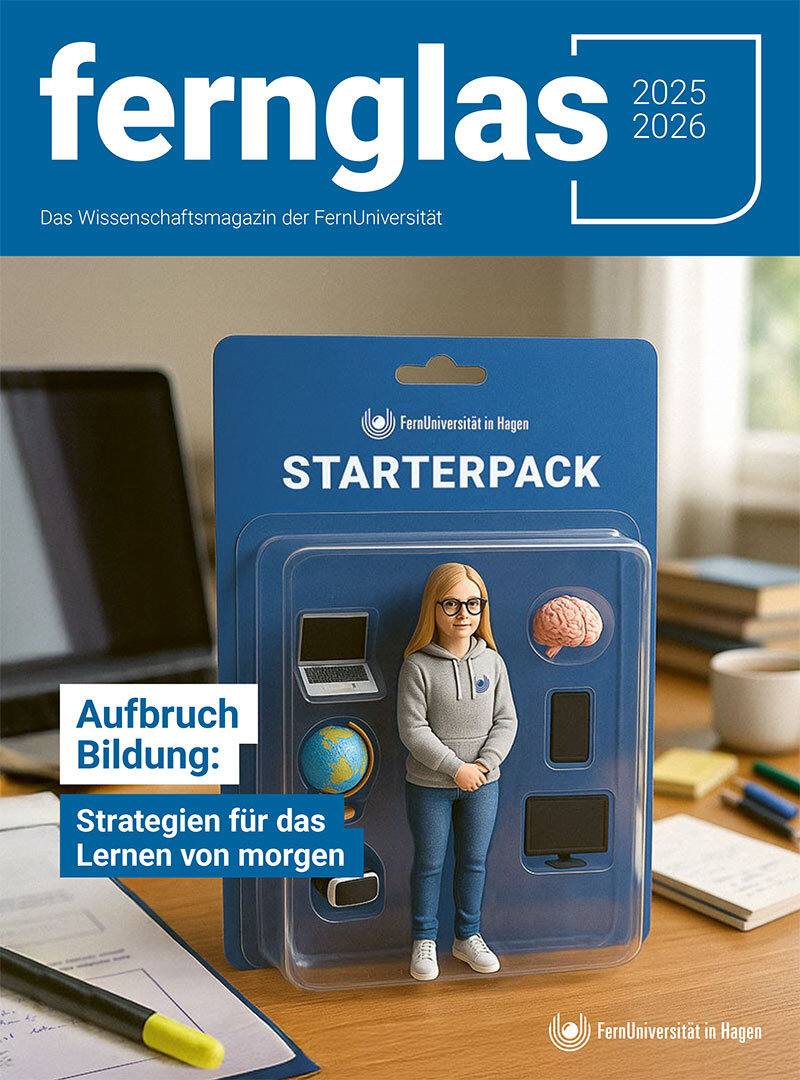
Article from the science magazine fernglas 2025/2026 (German). To the issue
Are you actively involving students in the development of new learning tools?
Oden: In high-performance computing, you still spend a lot of time sitting in front of a black console and typing commands. Personally, I don't mind that, but many people are put off by it. That's why we start with Jupyter Notebooks. We have expanded the environment with additional features that better visualize performance, for example. Several theses have already been written on this topic. In these theses, the students not only further developed the tool but also explored what lies behind it. That's very important to me. I want them to understand the background.
Specht: I do this in all phases of the study program. For example, we took a similar approach with master's theses. We use Jupyter Notebooks to learn programming in statistics. Then, the master's students create variations of this learning environment and examine the possibilities, advantages, and disadvantages they offer.
We should try to better understand how certain technologies can be beneficial.
Prof. Dr. Marcus Specht
Does the professional experience that FernUni students often bring with them play a role in this?
Oden: In computer science, many of our students are career changers, often without a technical background. This has an impact on their studies. You can definitely tell the difference in how people approach problems.
Specht: I also find it super exciting to learn about the students' backgrounds. When they come to us with a problem from their everyday work for their thesis and want to solve it using the methods they learned in their studies, they are usually highly motivated and knowledgeable about the context. They also have a real need to solve a practical problem.
Oden: I think it's a great opportunity for FernUni that we have so many diverse students. They're an incredible group of people from different backgrounds – a real treasure that we should make use of.
